


Today’s world is shaped deeply by the policy responses to the financial crisis and the pandemic. We see it not just in the global economy that has emerged from those two downturns, but also in our current politics and social dynamics. That governments and central banks responded in the way they did is in large part thanks to the two economists who just won the 2026 Nobel Prize in Economics: Robert Hall and Michael Woodford.
Hall and Woodford did not write any of the economic support legislation that arose from those crises, and neither has ever led a central bank. But by asking a fundamental question—how do households and businesses change their behavior when their expectations about the future change—their work had massive implications for how we think about the economy and public policy, especially recession responses.
Hall and Woodford did not establish the importance of expectations in economics themselves. Milton Friedman won the 1976 economics Nobel in part for his work arguing that people base their spending today on what they expect to happen to their incomes over their whole lives, what economics has dubbed the “permanent income hypothesis.”
The upshot of the permanent income hypothesis is that a one-time windfall, like a bonus at work, and an ongoing raise might look on paper like they put the same amount in someone’s bank account this month. But they should produce different spending responses, since one is a temporary income boost and one is permanent.
Robert Lucas, the 1995 laureate, further extended these insights about expectations into what economics now calls “rational expectations”: that consumers and businesses take into account all available information, form views about future economic and policy outcomes like prices and taxes, and change their current behavior accordingly. Lucas criticized the mainstream macroeconomic models of the 1970s that did not incorporate such expectations and, partially as a result, completely missed the stagflation of that decade. In the decades since, economists have developed more nuanced views on the usefulness of rational expectations, especially in its strongest form. But there remains broad agreement that expectations are important in thinking about households and businesses.
Where Hall and Woodford come in is in testing and refining these insights. Say a worker learns that she will be getting a permanent raise in three months’ time. The permanent income hypothesis predicts that, with sufficient savings or access to borrowing, she will start spending more today, because she expects her income over her entire lifetime to be higher, and she prefers to “smooth” her consumption. The worker has incorporated the expected raise into her actual spending well before it shows up in her paycheck.
It is an interesting theory. And for anyone who has made a big purchase in anticipation of more income right around the corner, it tracks a common way consumers behave. But how to test it? One way is to try to explicitly model people’s expectations about their future income. But household surveys in the late 1970s typically did not ask about expectations, so Hall would have needed to field a new survey to glean this information. Not only would this have closed off the possibility of historical data to Hall, but survey responses can be uncertain and unreliable.
Instead, Hall’s insight was that if the permanent income hypothesis was right, then people were already spending according to their anticipated future income, and as such, their current spending incorporated everything they knew. That created a testable hypothesis: start with a forecast of future spending that is only based on current spending. Then forecast again, but this time incorporate additional information, like current or past income. If the new forecasts are more accurate, then current spending does not reflect all available information, and the permanent income hypothesis would be undermined. But if the new forecasts do not improve, then current consumption incorporates all information available to the household, just as the permanent income hypothesis predicts.
That is exactly what Hall (1978) found. He used post-World War II data in the United States (US) to build a forecasting model of consumption, and then he added data about past income to see if the model’s predictions became more accurate. They did not, confirming a core tenet of the permanent income hypothesis1: consumers have rational expectations, and they smooth consumption over time based on permanent income such that changes in consumption follow a random walk.
Other work by Hall complicated the permanent income hypothesis. Hall and Frederic Mishkin (1982) found that household food spending responded more strongly to persistent income changes than temporary ones, but the temporary response was larger than would be expected from theory alone. If, for example, a household without access to credit saw a temporary income boost—say, a stimulus check from the government in the midst of a financial crisis—it might lead to a larger spending response than predicted by the permanent income hypothesis, making policy more effective at boosting short-run demand than anticipated.
Hall also applied his work to interest rates. Since higher real returns (returns adjusted for expected inflation) make postponing consumption into the future more attractive, one might expect changing real interest rates to, by extension, change the timing of a household’s spending. Yet Hall (1988) found little evidence of a strong response in aggregate US consumption data. This implied that monetary policy, whose primary tool for guiding inflation is setting short-run interest rates to affect demand, might have less influence over consumer spending than previously thought.
Hall’s research interests are not limited to consumer spending. His seminal paper with Dale Jorgenson in 1967, for example, showed that tax policy could affect firms’ investment decisions by shifting the cost of using capital. The paper looked at accelerations in US tax depreciation schedules and increases in investment tax credits that had been enacted in the 1950s and 1960s, and it found that they boosted business investment. These findings remain deeply relevant today given debates on how investment tax provisions are affecting data center and artificial intelligence (AI) investment.
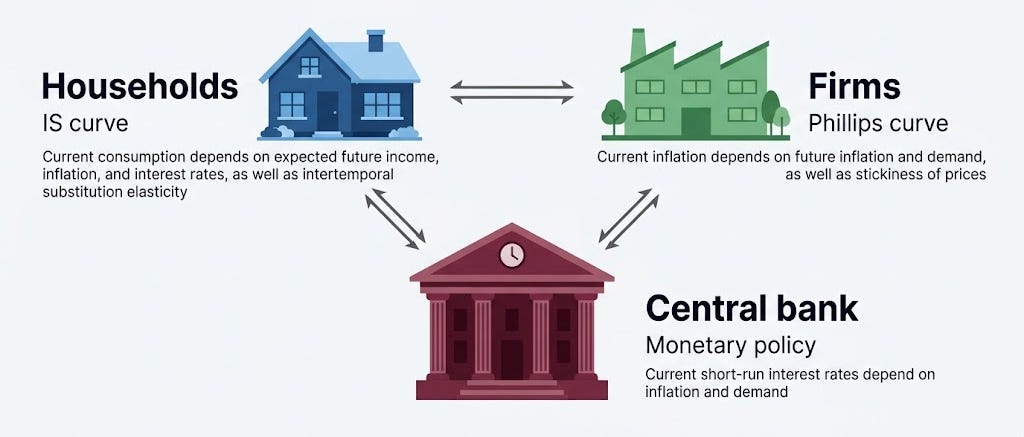
Where Hall’s work is broad and foundational, Woodford’s work takes those foundations, and it builds theoretical and empirical tools for policymakers. His name is most closely associated with the “New Keynesian” framework of macroeconomic modeling, which was laid out primarily in his 2003 book Interest and Prices and is arguably the most widely used approach in modern macroeconomic policymaking today. The simplest version of the New Keynesian model has just three equations, all tied together: one for households whose demand depends in part on future income (based on Hall’s permanent income work), one for firms who set prices based on expectations of future inflation and demand, and one for central banks who try to keep inflation and demand sustainable by setting short-run interest rates.
While today’s workhorse macroeconomic models tend to be much larger in practice—the Federal Reserve Board’s model of the United States economy (FRB/US) is nearly 400 equations—they are often built around the core New Keynesian relationships pioneered by Woodford. By explicitly incorporating expectations, Woodford’s framework forces policymakers to work through how their policy choices affect how people and firms behave.
This approach can offer insights on important economic questions. For example, if businesses are hesitant to cut prices in the midst of a downturn (“sticky prices”), they might be quicker to reduce production and cut jobs, since demand for their products goes down instead. That can make sense for individual businesses, but when aggregated up to the whole economy, it means that equipment and workers are left idle (which economists often call “slack”). Julio Rotemberg and Woodford’s 1998 framework connected these dynamics to household welfare, and it evaluated alternative central bank strategies to reduce slack and keep workers more fully employed.
Woodford, like Hall, also explains how tomorrow’s policy matters for today’s economy. Central banks set interest rates to control inflation and, in some cases, maximize employment. Businesses thinking about different investment opportunities will care deeply about future borrowing costs and demand, while households weighing a purchase now versus later will weigh prospects for future income, interest rates, and inflation. Eggertsson and Woodford (2003) showed, in particular, how useful that lens could be when central banks could not cut rates much further (the “zero lower bound”), an uncommon occurrence in advanced economies when they originally published that suddenly became the norm five years later during the Great Recession, and then again during the pandemic. They argued a credible commitment to maintain support into the economic recovery could encourage spending earlier during the slump.
Ultimately, Hall and Woodford’s Nobel is so richly deserved because in many ways they laid the intellectual foundations for how modern macroeconomics thinks about consumer and business behavior and how policymakers should respond. Their influence is everywhere we look in the economies of today.
An important asterisk, however, is that Hall found that while incorporating past income did not improve forecasts, incorporating past stock prices did, which contradicted the strict version of the permanent income hypothesis. Hall resolved this by proposing that while consumer spending reacted to changes in permanent income, some parts of spending might only do so with a lag.