


Recent academic research is coalescing around the finding that AI tools drive real productivity gains at the worker or firm level. LLMs or AI assistants have been found to make customer service agents 14% more productive on average (Brynjolfsson et al. 2023), and writers 40% faster, with writing increasing in quality (Noy and Zhang 2023). Consultants using LLMs see a 12% increase in tasks completed and a 25% reduction in time per task (Dell’Acqua et al. 2023). Knowledge workers using AI spent two fewer hours per week on email, according to a study of 66 firms (Dillon et al. 2025). These findings are even more compelling considering that most of this research uses older generations of LLMs. It stands to reason that as models have improved and adoption has risen, these effects will become more pronounced.
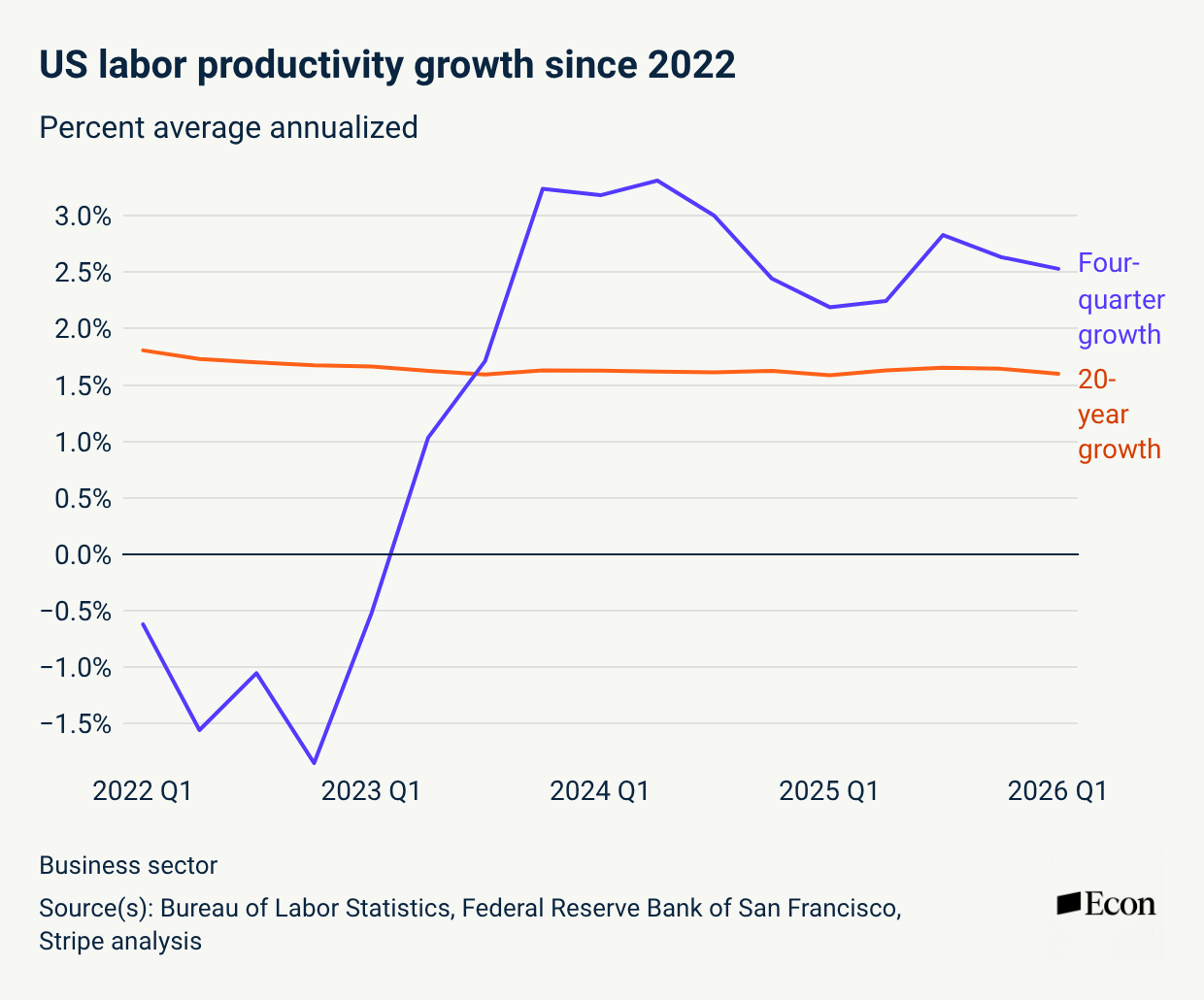
Alongside this mounting evidence of micro productivity gains, aggregate or macro productivity in the US has accelerated. US labor productivity has grown at roughly 2.5% over the past year—a meaningful outperformance over the 1.6% annual average of the last two decades.
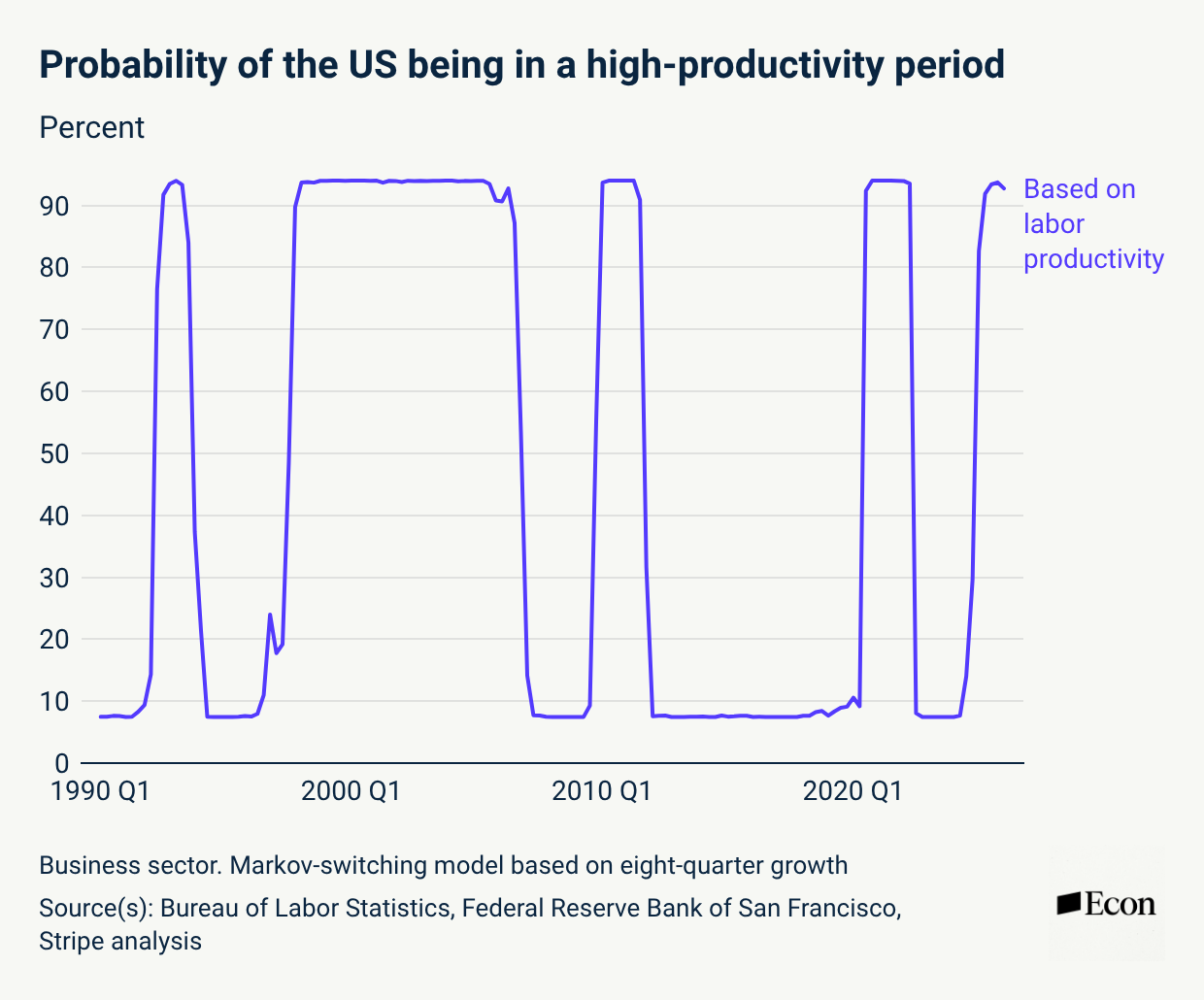
It now looks highly likely that the US is in a period of high productivity growth, at least for the time being. Our Markov-switching model—a tool used by economists to judge the likelihood that an economic measure is behaving meaningfully different than before—suggests a 93% probability the US has moved into a “high” productivity period, though as the chart below shows, this alone tells us very little about how long a high-productivity regime will last.1
The natural assumption might be that the boost to aggregate macroproductivity is a simple reflection of underlying microproductivity gains from AI at the worker and firm level. But in fact, while AI is likely part of the story, it’s not in the way most might think.
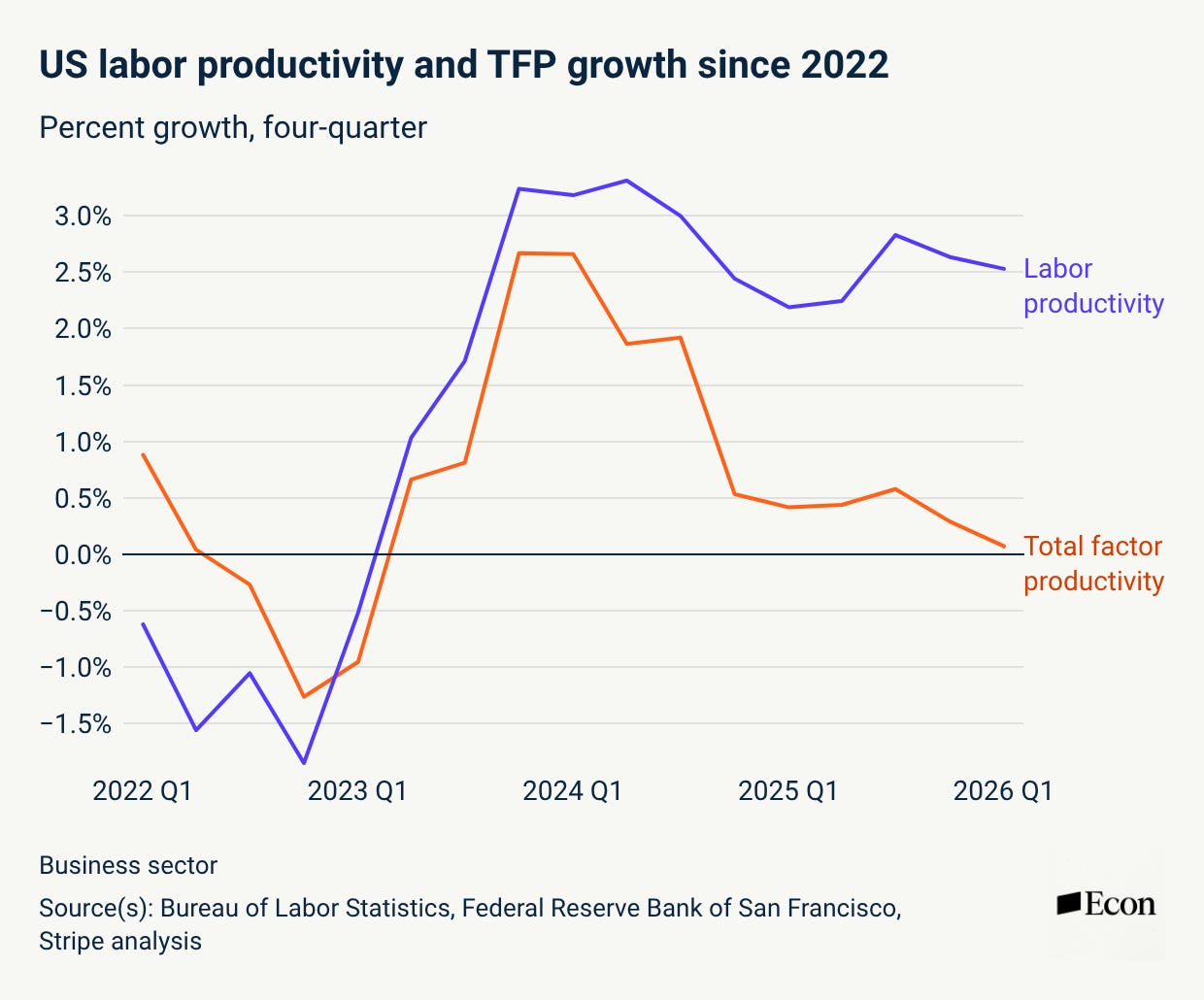
To start, there are reasons to be skeptical that even well-measured microproductivity gains are moving the needle much at the aggregate level at this point. We would expect, for example, that strong microproductivity gains would show up in estimates of total factor productivity (TFP). TFP is formally the portion of productivity growth not explained by increasing the amount of capital or labor being deployed in the economy; more informally, TFP is what economists think of as “pure” technological and efficiency growth, with the important caveat that TFP cannot be directly observed, and so must be estimated using economic models. If AI was making workers more productive at the frontier, TFP estimates should be accelerating just like overall labor productivity. But they aren’t: despite the strong headline labor productivity numbers, TFP growth has been near zero over the past year under the estimates developed by John Fernald and maintained by the San Francisco Fed.2
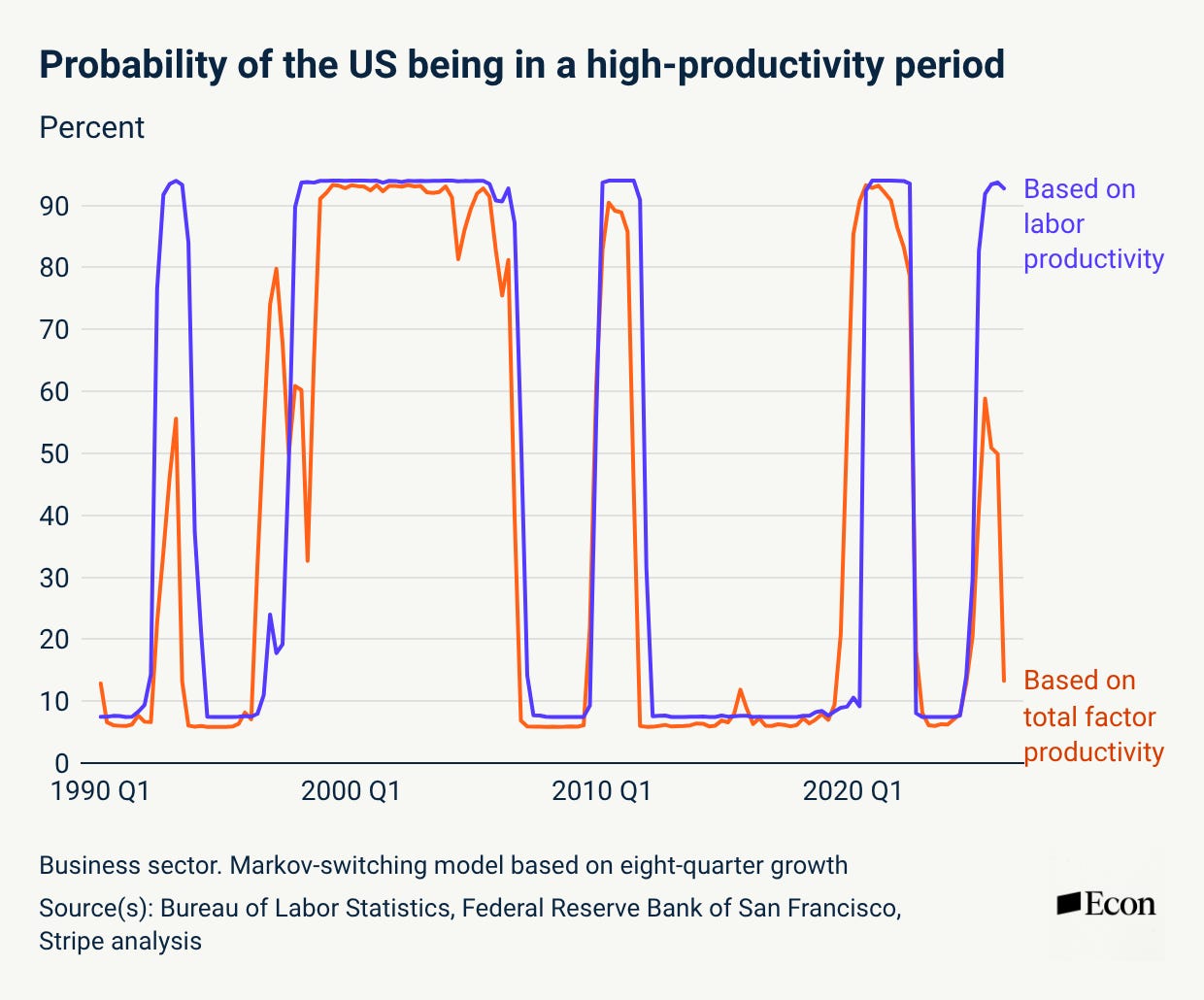
Our same Markov-switching model shows a less-than-20% probability the US is in a high-TFP-growth period.
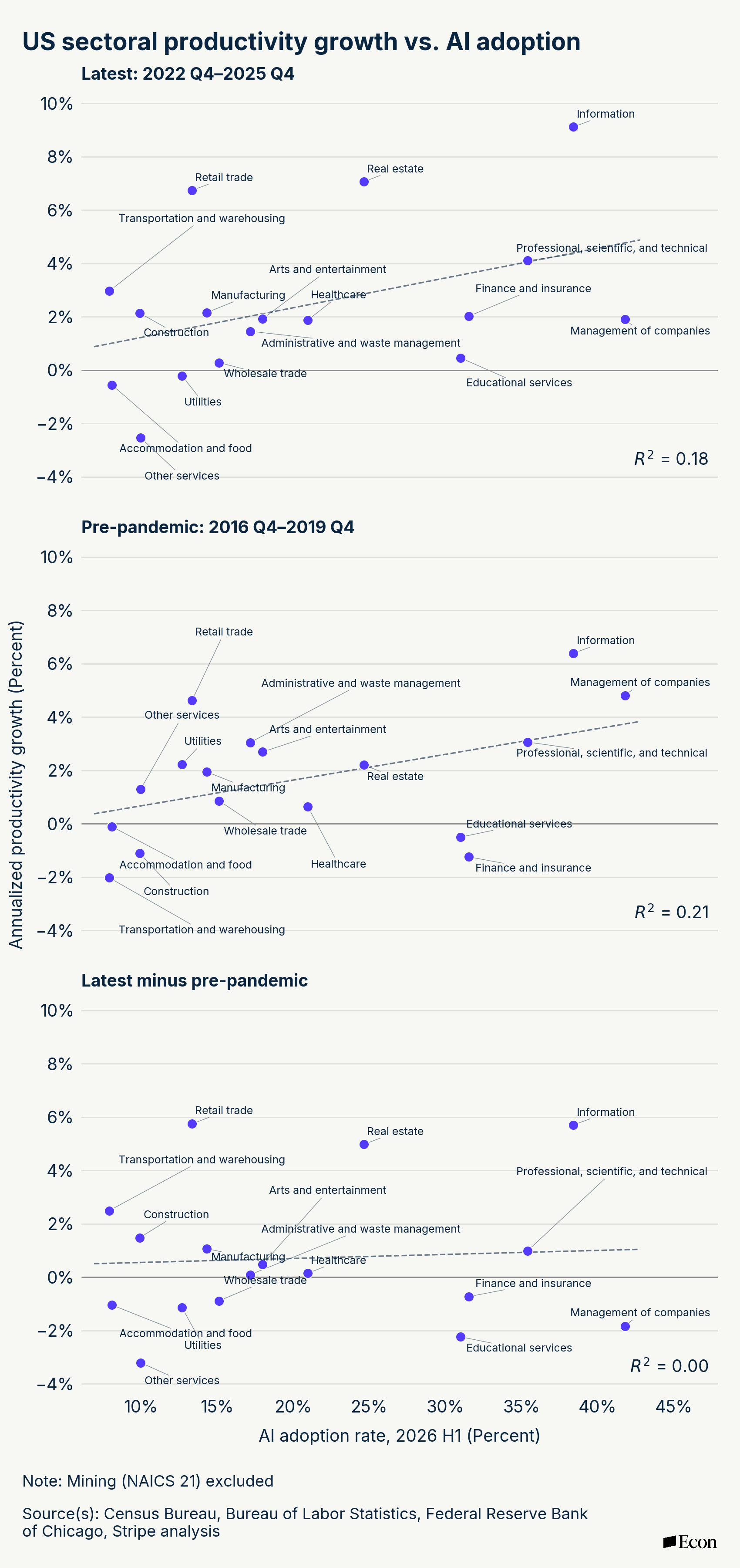
Moreover, industry-level productivity gains bear little relation to AI adoption. Combining recent AI adoption rates from the Census Bureau’s Business Trends and Outlook Survey (BTOS) alongside the Chicago Fed’s quarterly industry-level labor productivity (which we extend two quarters using its methodology), there is a positive, if modest, relationship between current AI adoption as self-reported by the business and recent productivity growth (top panel in the following image). But the same sectors that have adopted AI most heavily also showed stronger productivity growth over 2016–2019, when generative AI did not exist (middle panel). Strip out those pre-existing trends, and the residual correlation between AI adoption and recent productivity growth falls to essentially zero (bottom panel).
Put another way: the sectors with high AI adoption were already the ones from which we’d expect stronger productivity growth given the pre-pandemic experience. That doesn’t necessarily mean AI adoption isn’t weighing on aggregate productivity at all–—high pre-pandemic productivity might have fueled desire or ability to adopt AI now—but it does mean that such a relationship isn’t clear in the sectoral data.
This raises an obvious question: if there’s evidence that AI leads to microproductivity gains on specific tasks, why wouldn’t that be associated with stronger productivity growth in aggregate? A different strand of recent research gives one possible answer: AI may speed up bounded tasks without loosening the downstream constraints that determine final output. Economists at the Bank of Korea find that generative AI adoption reduces work time by 3.8% (about 1.5 hours per week), similar magnitudes to the Dillon paper cited earlier, but they also find that these savings have essentially no relationship with realized output growth unless workers have autonomy or strong incentives to reallocate the saved time productively (Suh et al. 2026). Other research shows the same attenuation in software: AI coding tools sharply increase commits and code volume, but the gains shrink at each higher production stage—from pull requests, to projects, to shipped releases—because review, integration, testing, release, discovery, and user adoption remain human bottlenecks (Demirer et al. 2026). That is, it speeds the inner loop, but not (yet) the outer loop, which becomes the binding constraint. In short, AI can create task-level efficiency before firms have redesigned workflows, incentives, and complementary processes enough for those gains to appear in aggregate productivity.
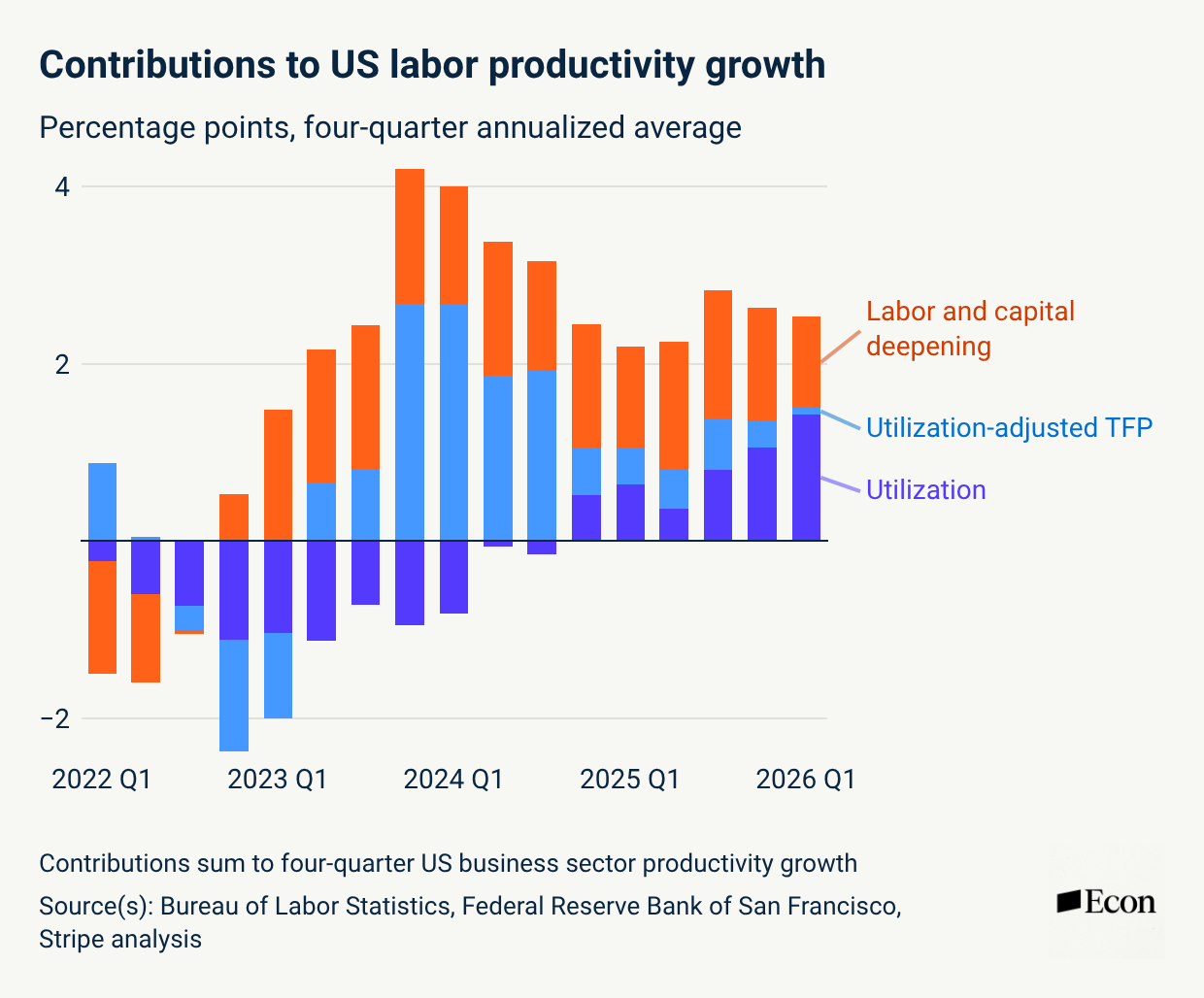
But if the human bottleneck hypothesis were correct, then why is aggregate labor productivity accelerating in the US? What appears to be lifting US labor productivity, rather than microproductivity gains, are macroproductivity gains from AI—specifically companies running their existing capital harder. Think longer runs of factories already built, more utilization of server racks and GPU clusters already paid for, and more occupancy of existing hotel rooms. Economists call this “capital intensity” or “utilization.” Higher capital utilization represents real economic gains, but it’s not the same as microproductivity. We can see this in the rising contribution of utilization in the Fernald TFP estimates, which—other than during the pandemic bounceback—are higher than they have been in decades. This is not the same as “capital deepening” (growth in measured productivity from expanding capital supply—for example, through capital investment). But utilization and deepening are often correlated: a firm that is motivated to boost capex will also likely be pushing its existing capital harder. Fernald himself and coauthors come to a similar conclusion in a recent VoxEU piece (Boyle, Fernald, and Li 2026).
None of this is a pessimistic read of AI. For one, much of the research is based on GPT-2 through GPT-4 era models. If task-level AI gains in the 10%–40% range are multiplied in more recent models (highly plausible anecdotally), if firms are getting better at integrating models into their workflows, and if they are sustained and become more widely diffused, then eventually those microproductivity gains will move the dial more in the aggregate data. There’s increasing academic evidence that such gains are achievable. Moreover, if human or other bottlenecks are the binding constraint on AI productivity gains, then firms will gradually reorganize to unlock them, just as they have done in response to prior technological shocks.
What the current numbers do not yet support, however, is the claim that this transmission is already well underway at the aggregate level: adoption is too thin, the cross-sectional signal is too weak, downstream bottlenecks remain, and the productivity pickup is too attributable to utilization to be confident in that conclusion. Instead, the acceleration we’re seeing so far is largely a result of companies trying to meet the demand for AI capacity by pushing the limits of their existing infrastructure.
Researchers at the San Francisco Fed recently performed a similar exercise and found a 57 percent probability of the US being in a high-labor-productivity regime as of the end of 2025 (Abdelrahman and Foerster 2026).
An alternative TFP estimate from the Bureau of Labor Statistics (BLS) shows TFP growth of 0.8% in 2025; not 0, but still not as extraordinary as recent labor productivity growth, as the BLS series is almost exactly in line with its prior 10-year average.
The productivity story makes more sense to me when assistance and delegation are kept separate. A tool can make someone faster without becoming a reliable coworker. The stronger claim needs evidence about handoff, review, ownership and where the work actually lands.
I think we should set aside the GPT assumption for a moment—blockchain passed many of the same early tests. Technological capability does not predict economic transformation, so we should focus on what we can actually observe.
We have abundant evidence that LLMs are powerful tools. Google's latest research is a good example of this: https://blog.google/innovation-and-ai/technology/research/understanding-the-ai-economy/
On the other hand, if we separate the economic activity due to the speculative data centre build-out from realised productivity gains, the evidence for firm- or economy-wide transformation is much scarcer. Your data shows this tension nicely.
There is a lot of comparison with electrification, but the analogy needs care. Electrification’s breakthrough came from decoupling power consumption from generation. The key shift was not replacing steam engines with electric motors; it was changing the architecture of production by relocating power generation and distributing power through a network. Steam power generation benefits from the square-cube law: larger centralised generators are more efficient, and the more demand the network attracted, the more valuable the infrastructure became.
The benefits we see from LLMs today emerge from the tip of the tool: the interaction between a model, prompt, and context. We have not seen a network effect from AI. This is not to say such a network will not emerge, but we should be honest that we do not see one today.
So perhaps the more interesting question is not:
> “How much is AI contributing to GDP?”
but:
> “How much of the current AI GDP contribution survives after removing the construction boom required to make AI possible?”