


In a previous post, we argued that AI appears to be behind a significant increase in entrepreneurship, particularly among solopreneurs. Part of the reason is that AI fills the capability gaps that used to require other people with complementary skills. One possible implication of this is that cities—where people go to meet other people—could become less valuable in the age of AI.
This debate has played out before. During the COVID-19 pandemic, work from home provoked predictions about the end of cities. So too did the rise of email and instant messaging, and before that, the telephone, and earlier still, the telegraph.
There are many reasons to believe that technology could weaken agglomeration effects, but history shows that the substitution of technology for in-person interaction is not straightforward. Cities benefit from both centripetal forces that draw firms and individuals in, such as shared infrastructure, amenities, and deep labor markets; and from centrifugal forces that push people out, such as congestion, high housing costs, and crime (Krugman 1996). New technological waves often act in both directions, and it is difficult to predict ex ante what the net effect will be.
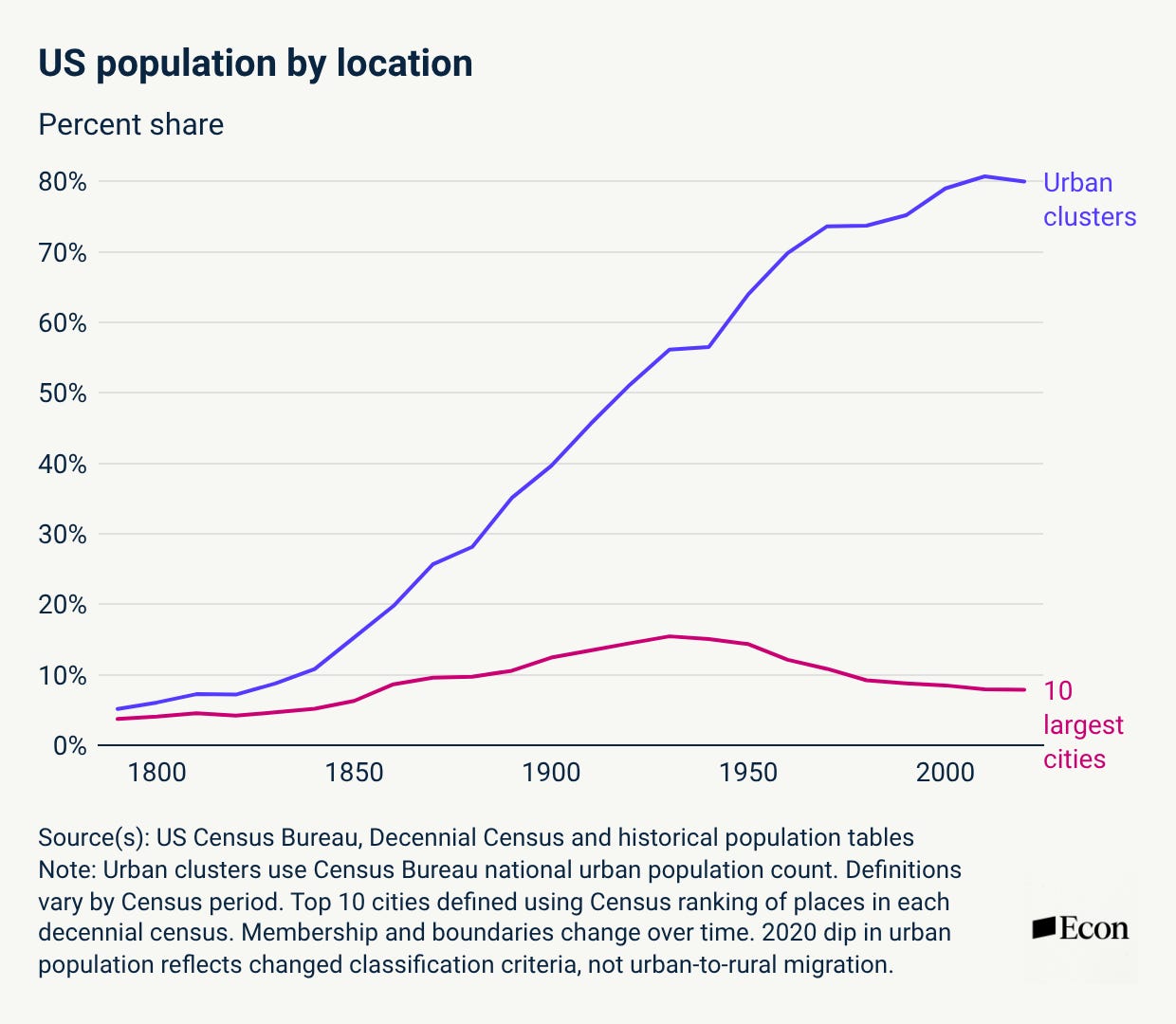
Overall urbanization has been rising for over a century, but specific cities and neighborhoods within them rise and fall relative to each other. Jobs move to new places for two reasons: existing companies grow, shrink or relocate, and new companies get founded elsewhere. Stripe’s data allows us to observe the latter particularly well.
We find that AI-era businesses (which we define as companies that were started from 2024 and on, and which includes both AI companies and non-AI companies) are far more distributed than before. Close to 40% of new businesses on Stripe this year are in metros with fewer than one million people, up 10% relative to four years ago. This year, twice as many new businesses were formed per person in Cheyenne, Wyoming as in New York City; in 2022, the rates of business formation in both cities were equal. And even for businesses still forming within major metros, they are increasingly forming in the outer suburbs rather than in city centers and high-density areas: the share of businesses forming in outer suburbs is up by as much as three to four percentage points in metros such as Houston, Austin, Tampa, Orlando, and Dallas in the last few years.
There are two caveats to the AI-era story. First, there have been other factors influencing the spread of business formation, particularly the post-COVID-19 rise of remote work, and it might be challenging to entirely disentangle these. Second, not all AI-era businesses are more distributed geographically. In fact, the companies that are most responsible for AI development itself—AI labs and AI product companies—continue to cluster in major metro areas.
New businesses in the AI era are less concentrated in major cities than in the past
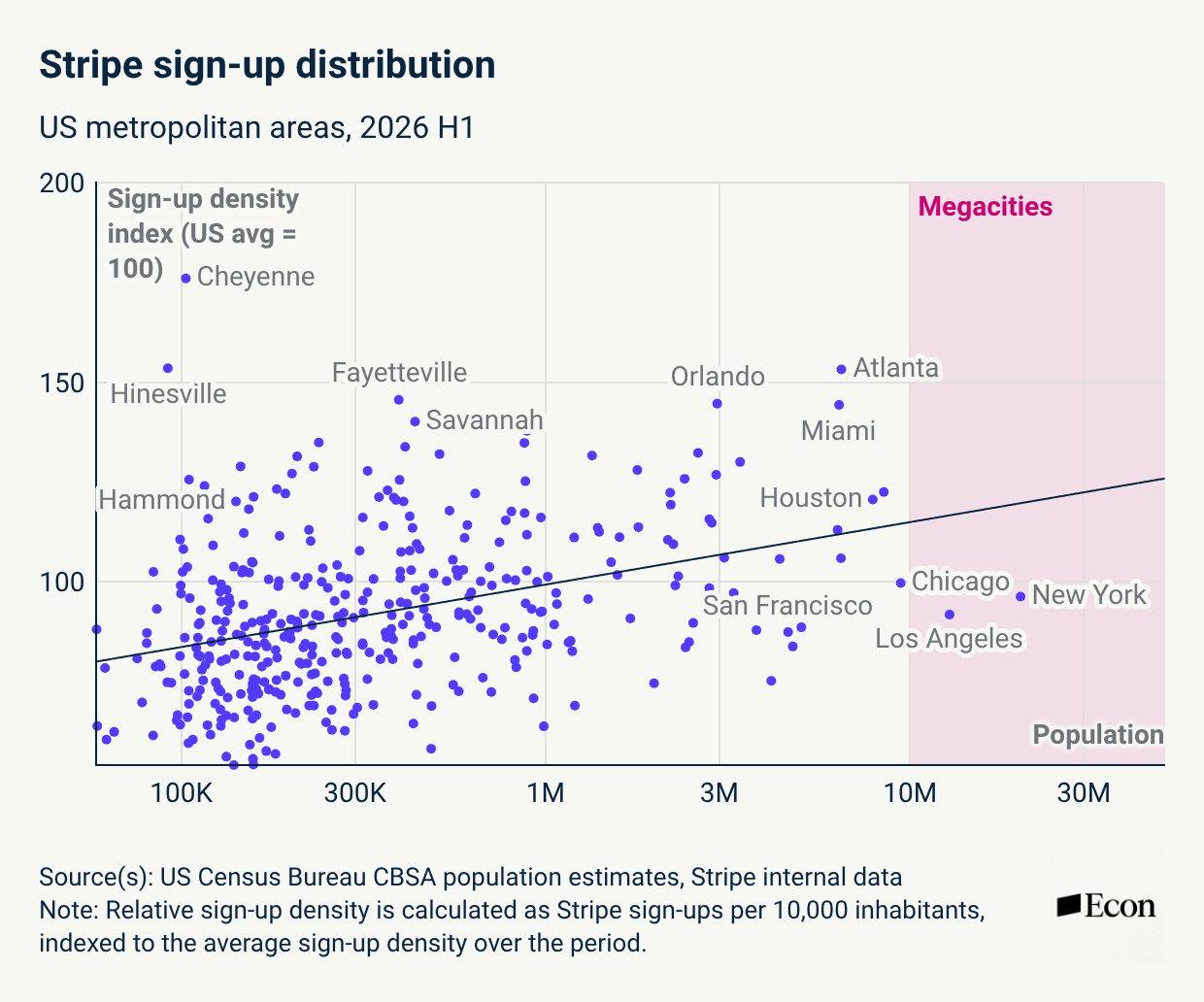
At first glance, AI-era business formation appears to be broadly distributed across the United States. While larger metros do on average see higher sign-up density than smaller metros and micropolitan areas, the distribution of sign-ups is not especially concentrated. We find smaller metro areas like Hinesville, Georgia (population 90,000), Cheyenne, Wyoming (100,000), and Fayetteville, North Carolina (390,000) among the densest hubs for new business formation. Meanwhile, major metro areas that one would expect to be at the core of this surge in new businesses—like New York, Los Angeles, or San Francisco—are seeing below-average business formation relative to their sizes.
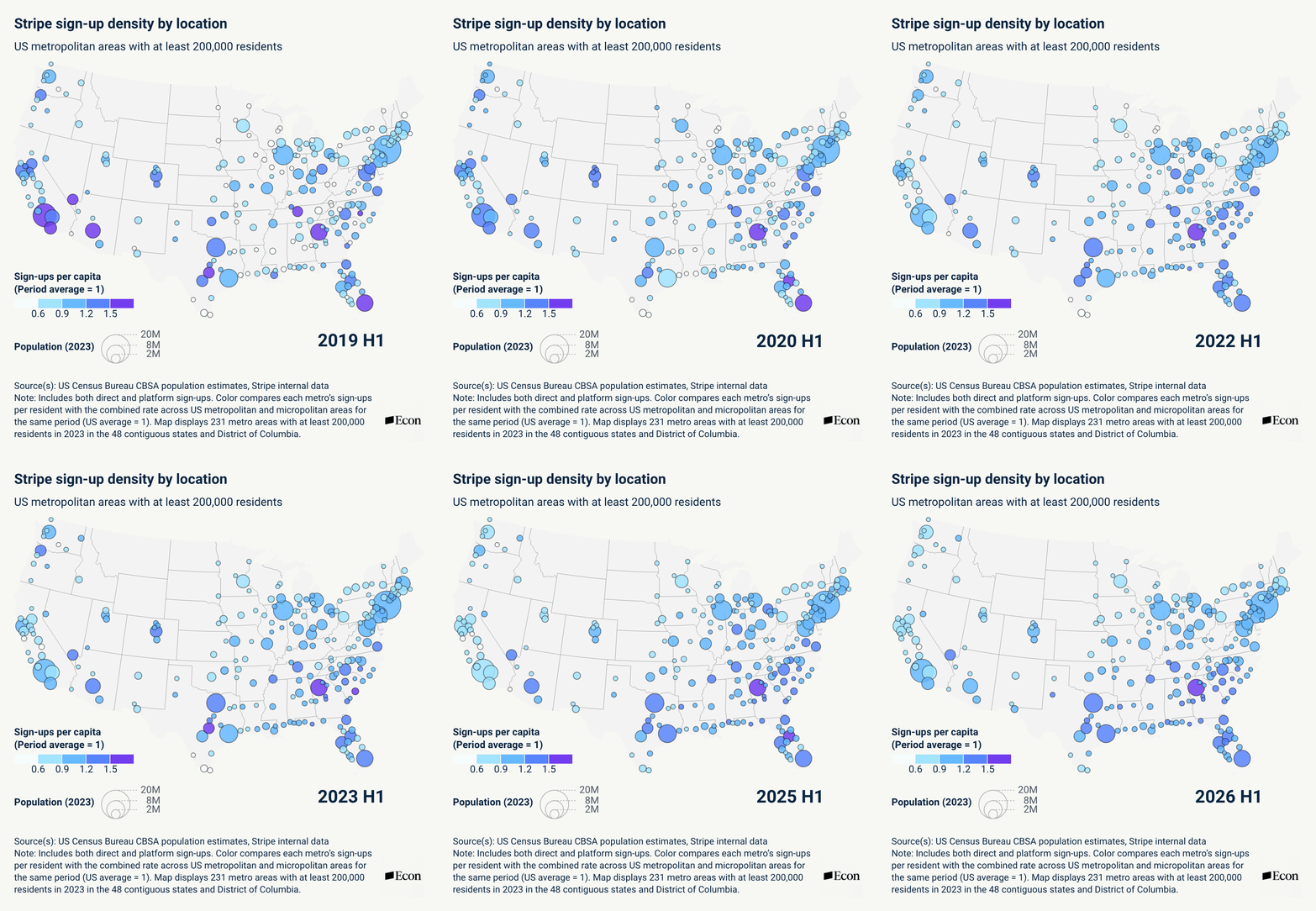
To see how this compares to historical trends, we map Stripe sign-ups relative to population across US metro areas larger than 200,000 people from 2019 (which we use as our pre-COVID-19 baseline) to 2026. Micropolitan areas are excluded from this map for legibility but included in our analysis. Here we see that the current AI-era distributed formation is actually a continuation of a broader shift in entrepreneurial activity away from major metropolitan areas (larger bubbles getting lighter) and toward secondary metros (smaller bubbles getting darker).
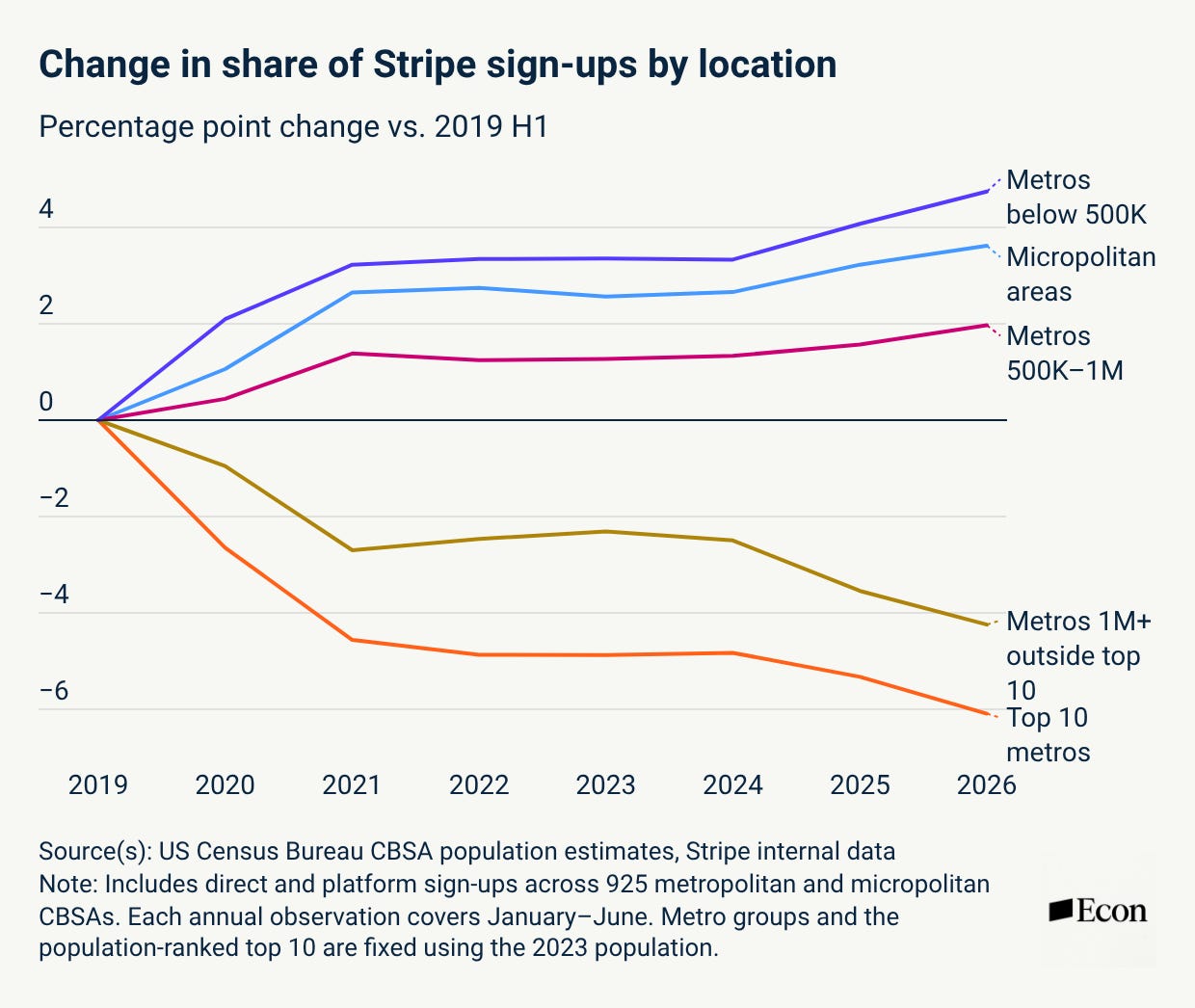
Business formation is up across the country, so to understand relative winners and losers, we need to look at how the share of businesses forming in different locations is changing. This confirms what the map suggests, which is a gradual move away from larger metro areas (top 10 and metros with more than one million people) and toward smaller metros and micropolitan areas.
The biggest jump happened during COVID-19 as a consequence of work from home, but the general trajectory has continued in recent years and appears to be reaccelerating since 2024, closely tracking the AI era. The shift we’re seeing now is also reflected in Census data and is roughly one third as large as the COVID-era move away from major cities.
Within major cities, AI-era businesses are also less clustered in city centers
Within major cities, we also see that Stripe sign-ups are widely distributed outside of city centers. If agglomeration effects were key to AI-era business formation, you might expect to see the share of sign-ups in city centers and high-density areas vastly outweighing population share. Instead, sign-ups track population distribution within cities closely, and close to 80% of sign-ups in major metropolitan areas are outside of the city center and high-density inner ring.
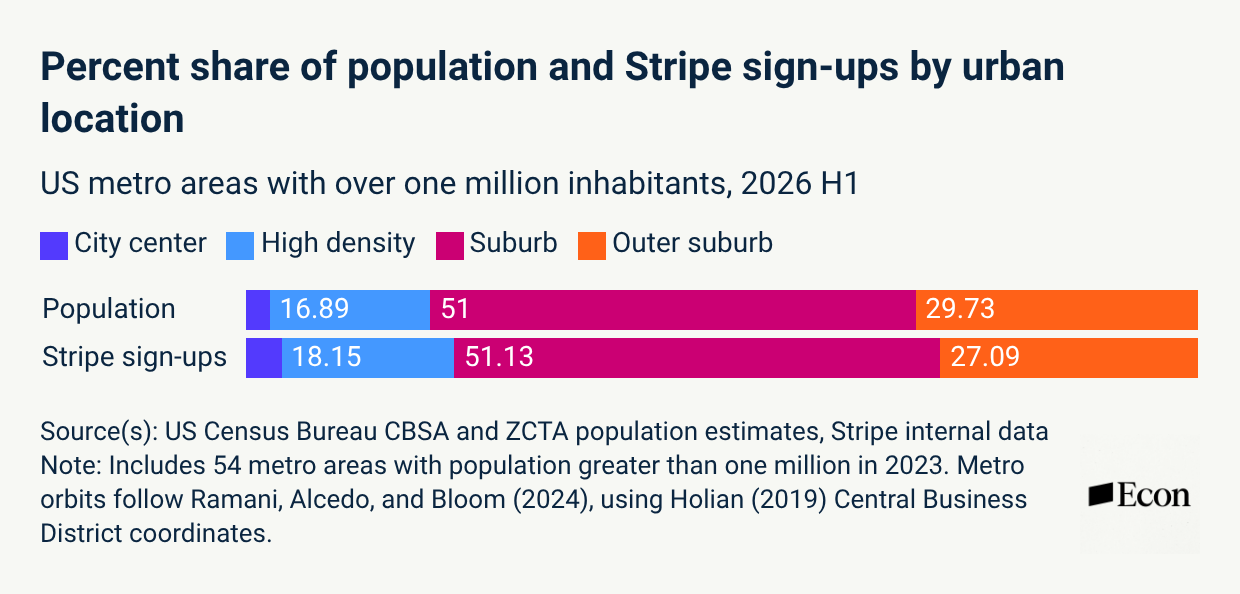
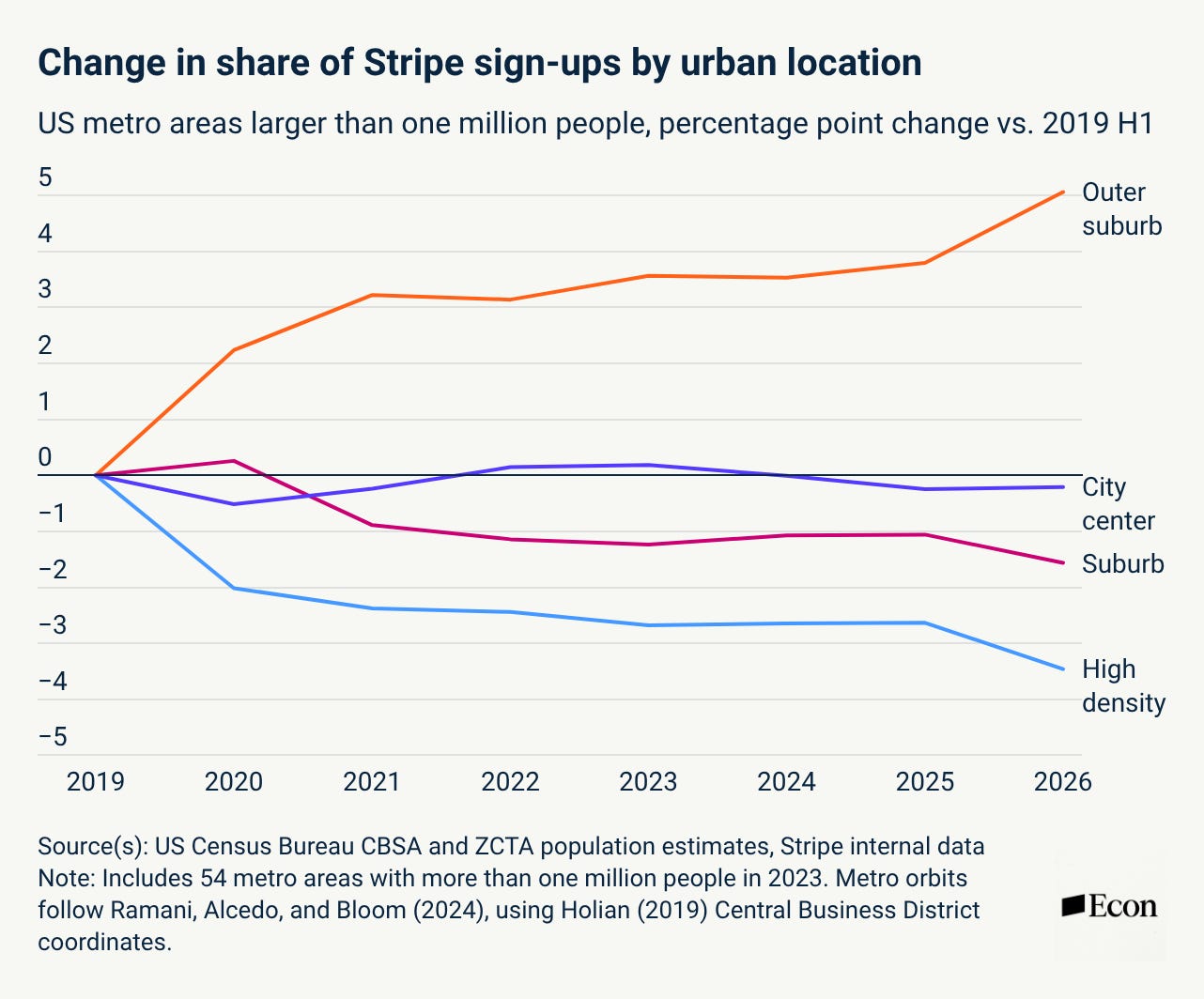
What’s more, this distribution marks a change from previous waves of business formation. Much like the trend away from major metros, the shift in business formation away from city centers and toward outer suburbs has reaccelerated recently, relative to the post-COVID-19 plateau. Houston saw 37% of new businesses forming in the outer suburbs this year, up four percentage points relative to 2023. While this is a particularly stark example, the general trend holds across most major metros. The COVID-19-era trend is well documented in the literature (Ramani and Bloom 2021, Decker and Haltiwanger 2023), though to our knowledge, the recent reacceleration in this trend has not been covered elsewhere.
Disentangling AI from work from home is complicated
The data on AI-era business formation would thus appear to be consistent with AI dampening the value of agglomeration in major metros. But the extent to which AI is independently causing this change is hard to untangle. One confounding factor is the interaction between AI and work from home. For example, AI might be unlocking latent entrepreneurial potential among individuals that relocated with work from home policies—a continuation of the entrepreneurial activity spawning from remote work documented in the literature (Kwan et al. 2024).
If this were true, we might expect to see businesses disproportionately forming in areas with high levels of work from home. Our data does not currently support this. Business formation appears uncorrelated with work from home intensity, and that holds whether we look across metro areas or at the distribution of businesses within them. Still, this is not enough to conclude that AI-era business formation would be as widely distributed absent work from home.


AI work itself is immune to this effect
That AI-era business formation is broadly distributed does not mean that agglomeration does not matter with Al. In general, knowledge at the technological frontier is highly tacit, and frontier firms cluster in major cities to benefit from knowledge spillovers in their domain. The field of AI development itself is no different. If anything, the speed at which innovation in AI is moving would suggest that the proximity of cities should be even more valuable.
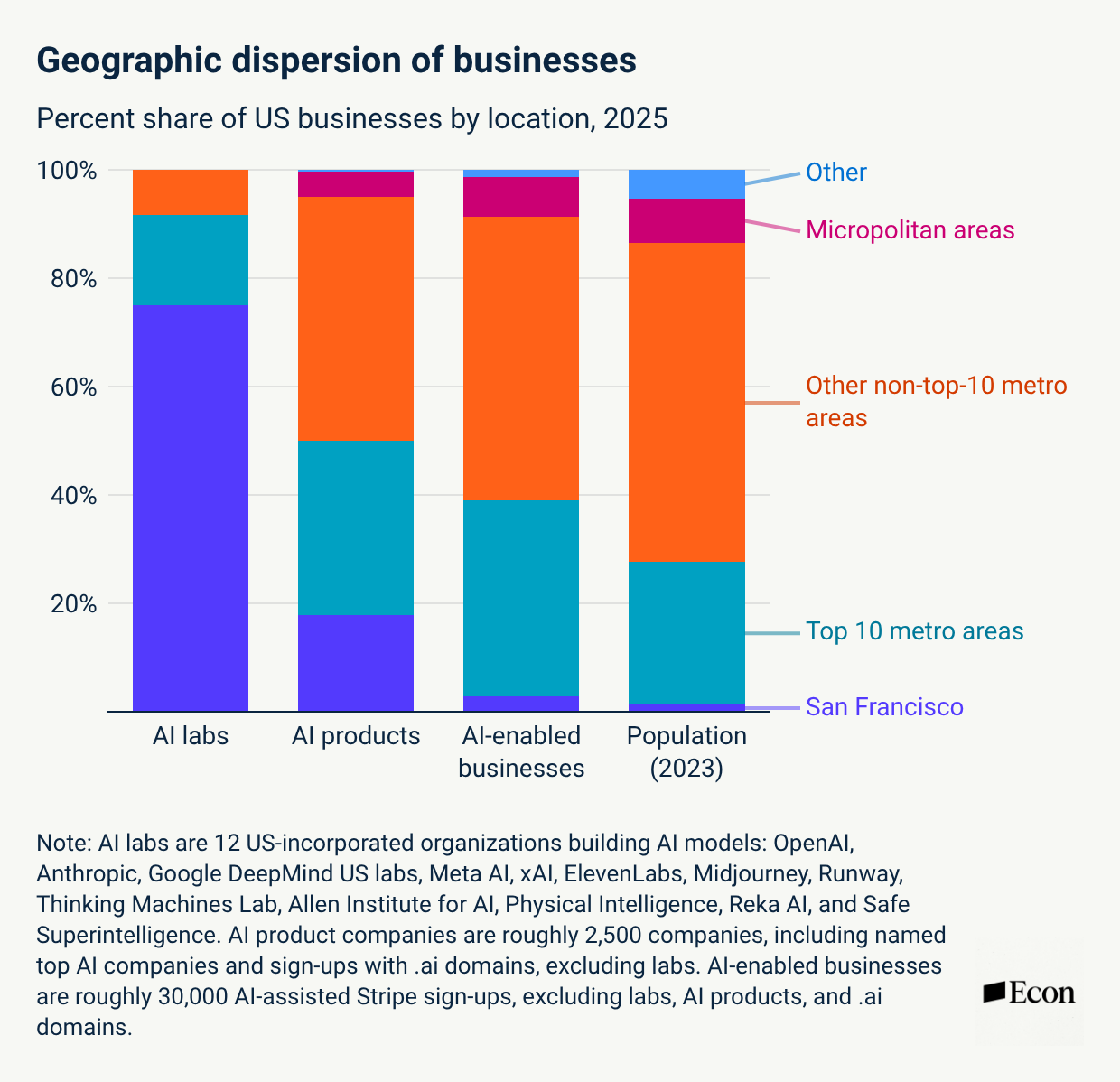
Stripe data allows us to test this empirically. We can categorize AI-era businesses in three groups, according to their distance from the technological frontier. First are the AI labs themselves. Then there are businesses in which AI is part of the product. Finally, there are businesses that are AI-enabled, but that are building and selling non-AI products.
Aligned with our hypothesis, these different types of businesses show different spatial distribution, with those closest to the technological frontier clustering most tightly in big cities. Almost 80% of AI businesses closest to the technological frontier (the labs) are in San Francisco alone. Among AI product companies, which are also innovating close to the frontier, 50% are in San Francisco or top 10 metro areas. Finally, it’s the AI-enabled businesses that are most widely distributed across the country.
Conclusions
US business formation in the AI era appears to be more decentralized than previous waves: a higher share of firms are forming outside of major cities; and even among firms forming in major cities, a growing share are forming outside the city centers.
We saw this trend during COVID-19 with the rise of work from home, but it has reaccelerated in the last few years, coinciding with the advent of AI.
While it’s hard to fully disentangle this shift from changes driven by work from home, the distribution of AI-era businesses appears uncorrelated with work from home intensity at the city level.
The subset of new firms closest to the technological frontier—labs and AI product companies—continue to cluster more tightly in San Francisco and other major metro areas, presumably because of the continued benefits of agglomeration for innovation.
Cheyenne is due to the advantageous LLC laws in Wyoming.
I’d be curious to see the raw data, for example, Wyoming, Nevada, Delaware, and South Dakota are states with a race to the bottom-esque in corporate governance laws, and disentangling actual economic activity vs. LLC creation and development happening elsewhere.