


Online, the perception exists that Europe is falling behind in every part of AI. This is certainly true for some areas. Electricity prices in Europe are more than double the US. The US has more data center capacity than the next 14 countries combined. And despite some exciting recent announcements, Europe has no model that breaks the top 20 of either the main Artificial Analysis or Epoch AI rankings. But there are other areas, based on Stripe data, that look far less bad.
As Jensen Huang says, a simple way to think about AI development is as a layer cake. The bottom layer is infrastructure: electricity, chips, data centers. The middle layer is models: the weights that transform input tokens into output. The top layer is AI applications that use models (e.g., AI shopping agents for consumers or AI legal assistants for businesses). Finally, businesses and consumers eat the cake. This is adoption. The metaphor can help us see where Europe is ahead or behind the US.
It is well-documented that Europe lags at the bottom layer of the cake. But Stripe data shows that at the top of the cake—the AI application layer—the picture is much more nuanced. And for those that eat the cake—consumers and businesses—the differences between Europe and the US disappear almost entirely.
This is important. Wealthy economies require frontier innovation to grow, not just the adoption of tech produced elsewhere (Acemoglu, Aghion, and Zilibotti, 2006). But innovation in AI includes innovation at the application layer. And adoption also matters. If artificial intelligence is increasingly commoditized, value will accrue to the individuals and companies that make best use of it. And if, as our previous work suggests, AI plays the role of cofounder or employee for a growing number of businesses, the individuals who adopt AI early will be at an advantage.
AI application Layer: There are a lot of European AI product companies
If we compare the performance of US and European AI companies on Stripe that do not train their own models, the US lead is less commanding than at the model layer. At the aggregate level, American AI application companies on Stripe have achieved roughly 7x as much revenue as those in the EU and 15x as much as those in the UK. However, the US economy is about 50% larger than the EU in nominal terms and about 8x the size of the UK economy. Once we adjust for this difference, US aggregate AI application revenue is only 5x the size of that of the EU and only twice as large as that of the UK.
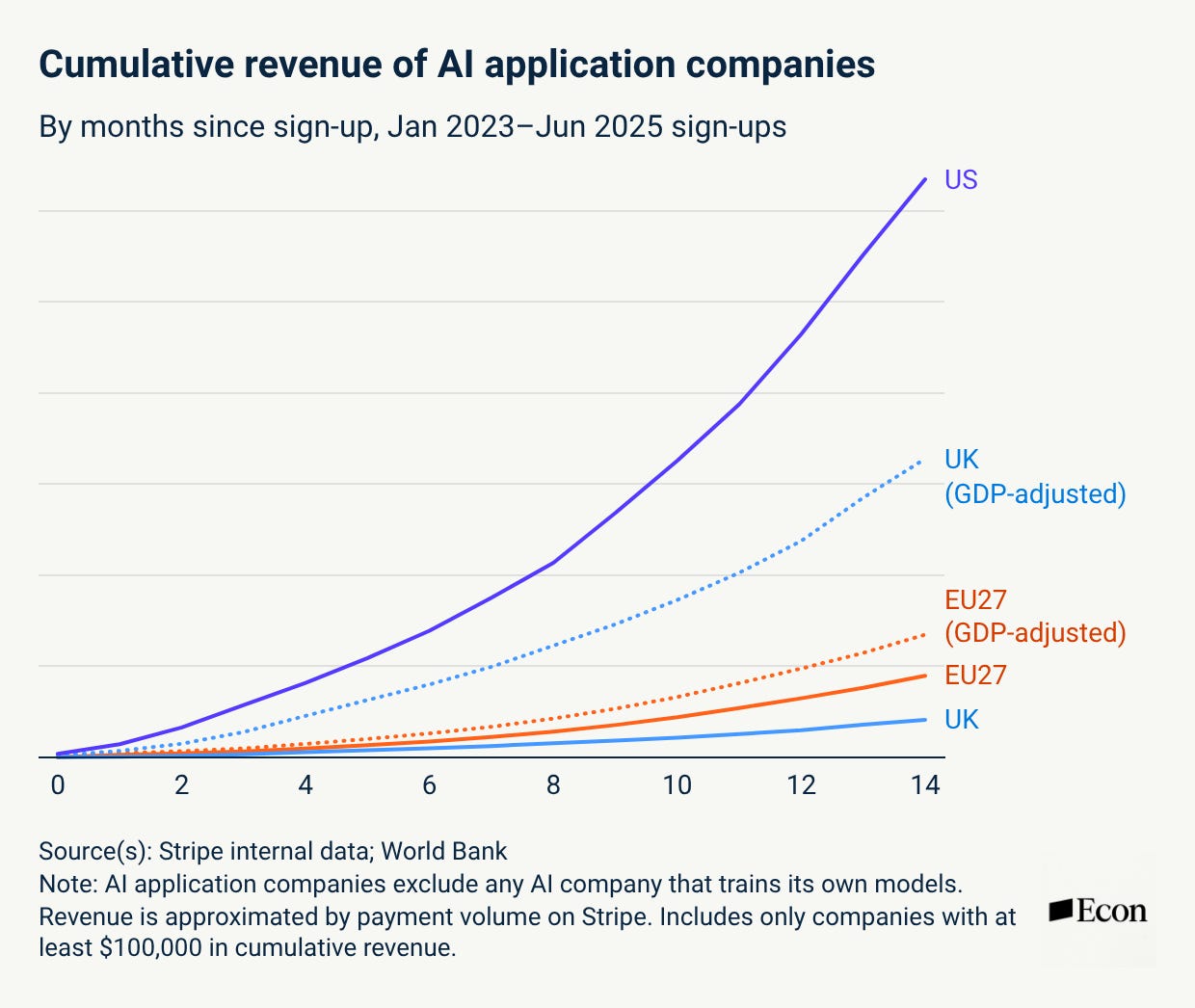
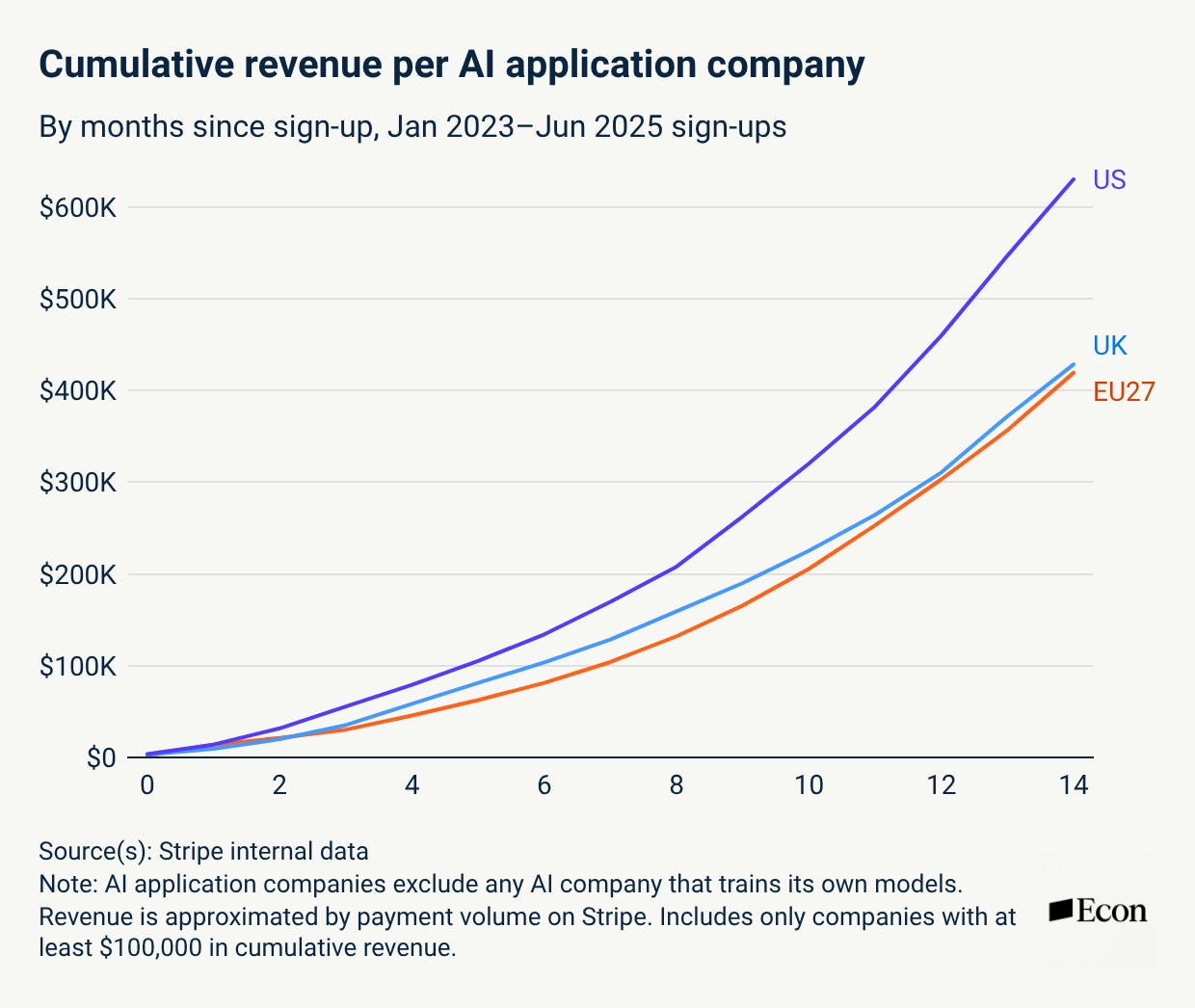
And if we decompose the delta into number of firms and average firm size, we find that the US lead at the application layer comes primarily from the amount of AI companies, not their size. There are roughly 5x as many AI companies in the US than Europe. But US AI application companies are on average only 50% larger than their EU or UK counterparts. This is not exactly cause for celebration but it is much better than the gulf at the model layer.
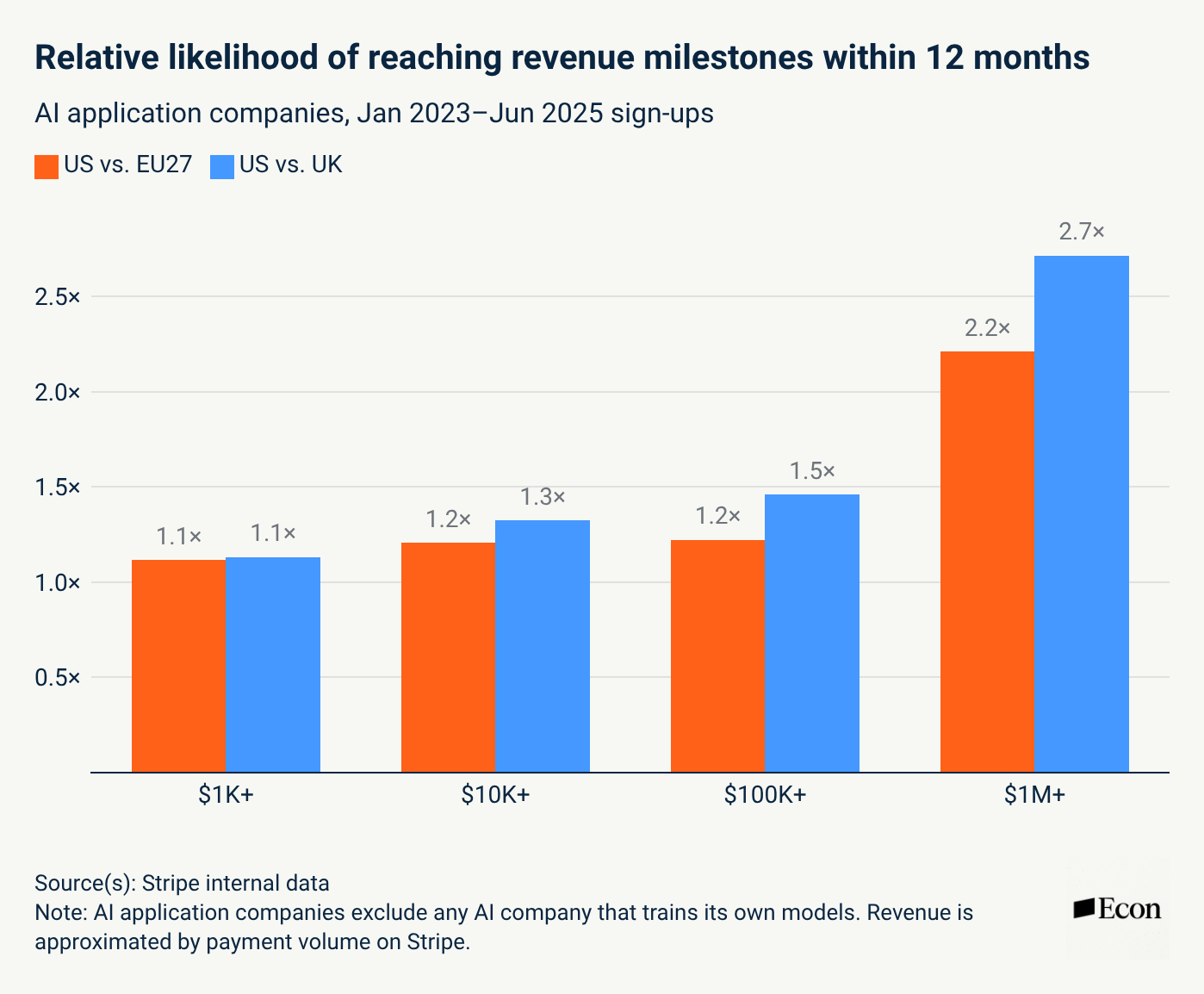
The average revenue gap between the US and Europe is largely driven by the lower prevalence of European “blockbuster” companies, those that have achieved over $1 million in revenue 12 months after sign-up. The average US AI product company is about as likely as a European one to reach $100,000 in revenue, but American AI companies are more than twice as likely to cross the million-dollar threshold. These $1 million and up companies make up close to 0.5% of AI application companies on Stripe in the US but are responsible for a disproportionate share of revenue. In Europe and the UK by contrast they are fewer (0.2%) and their contribution far smaller.
Consumer adoption: Fewer Europeans pay for AI, but those who do use the same as Americans
For consumers, the story is also more even. Stripe powers close to 90% of the Forbes AI 50 and tens of thousands of smaller AI companies. Its infrastructure allows these companies to sell their products to a globally distributed customer base across 195 countries. This gives us excellent visibility into consumer-paid adoption around the globe.
We look at the adoption of 34 of the most popular paid consumer AI tools across the US, UK, and EU27 since the 2022 launch of ChatGPT1 and find that EU consumer paid AI adoption is about 60% of that of the US. This may sound like a large gap, but it is only equivalent to a few percentage points. UK adoption tracks the US almost exactly.
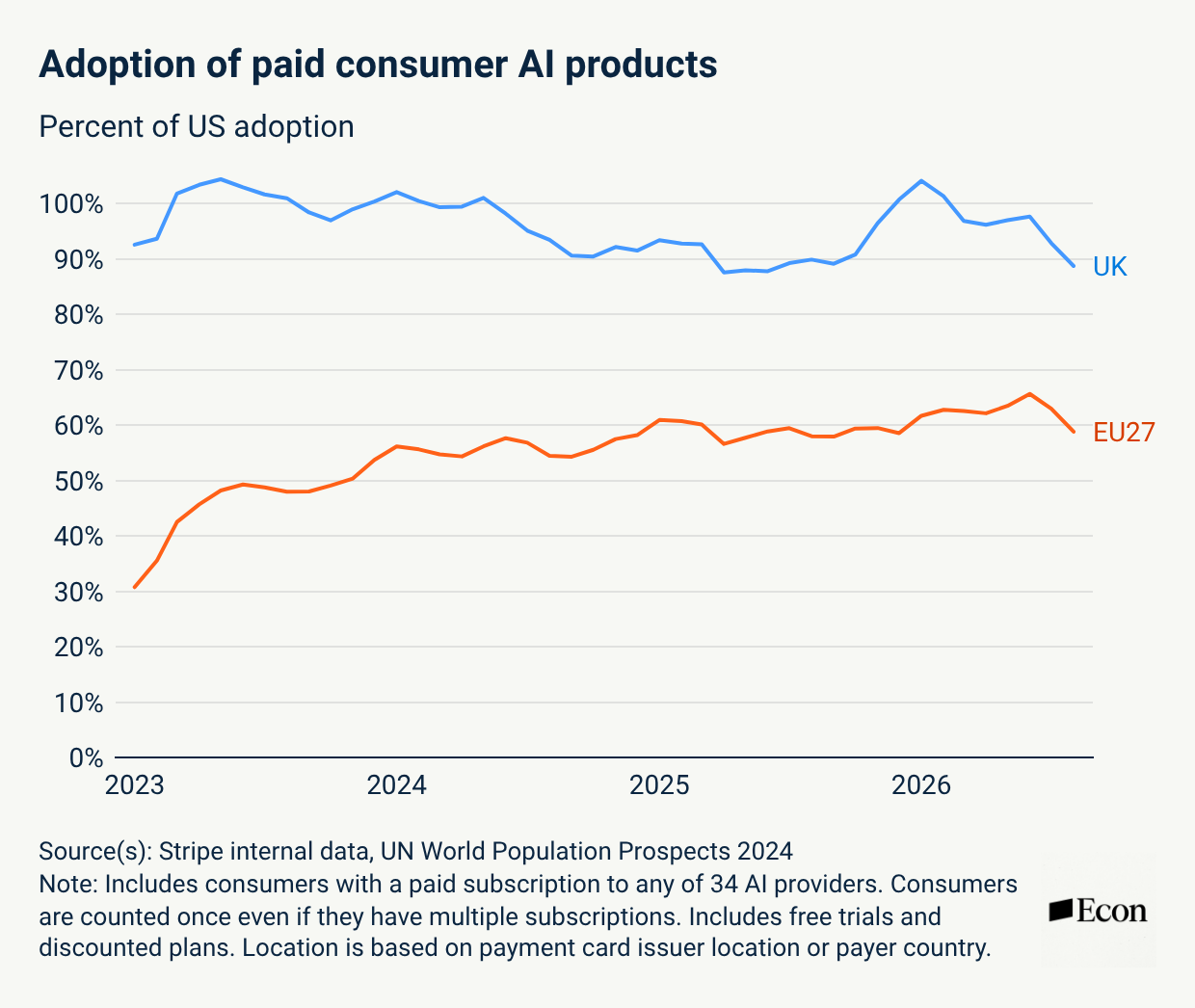
Paid AI adoption is a tiny fraction of all consumer AI use (which is estimated to be close to 50% in both markets), but we believe paid AI use is an appropriate metric to use. Willingness to pay reflects consumers deriving greater utility from AI, whether through the form of productivity gains or other enjoyment. Paid adoption, which is higher friction, is also where a difference between the EU and US adoption would be most likely to emerge.
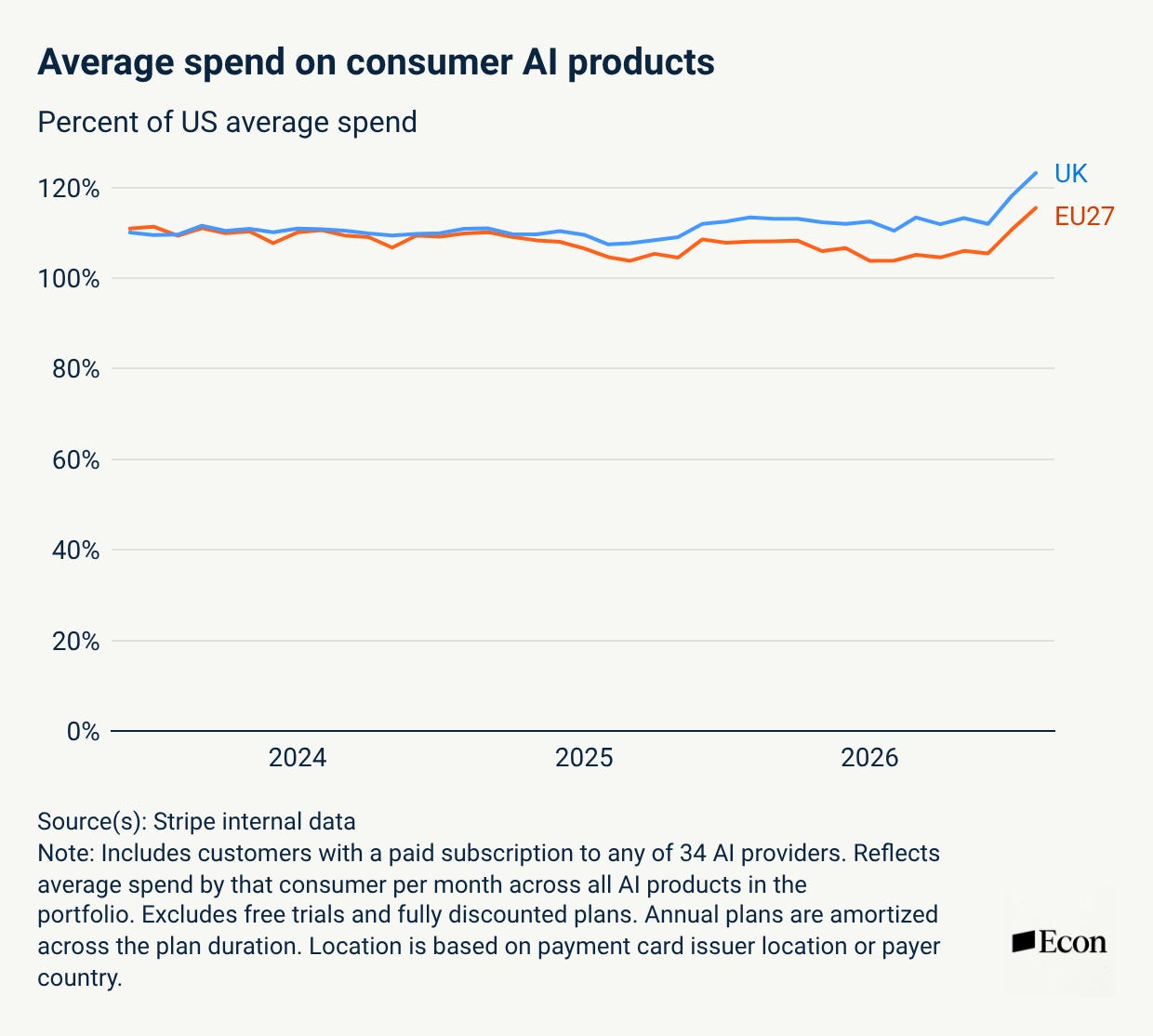
Still, anyone who uses AI themselves knows that intensity of use matters just as much as overall adoption; using an AI chatbot is very different from using an AI coding agent. We can proxy for intensity of use by looking at average spend per paying customer across all tools. Here Europe and the UK are keeping pace with the US. If anything, dollar spend per paying user is higher in the UK and Europe than it is in the US, though this may reflect a selection bias toward a more enthusiastic early-adopter population in these markets.
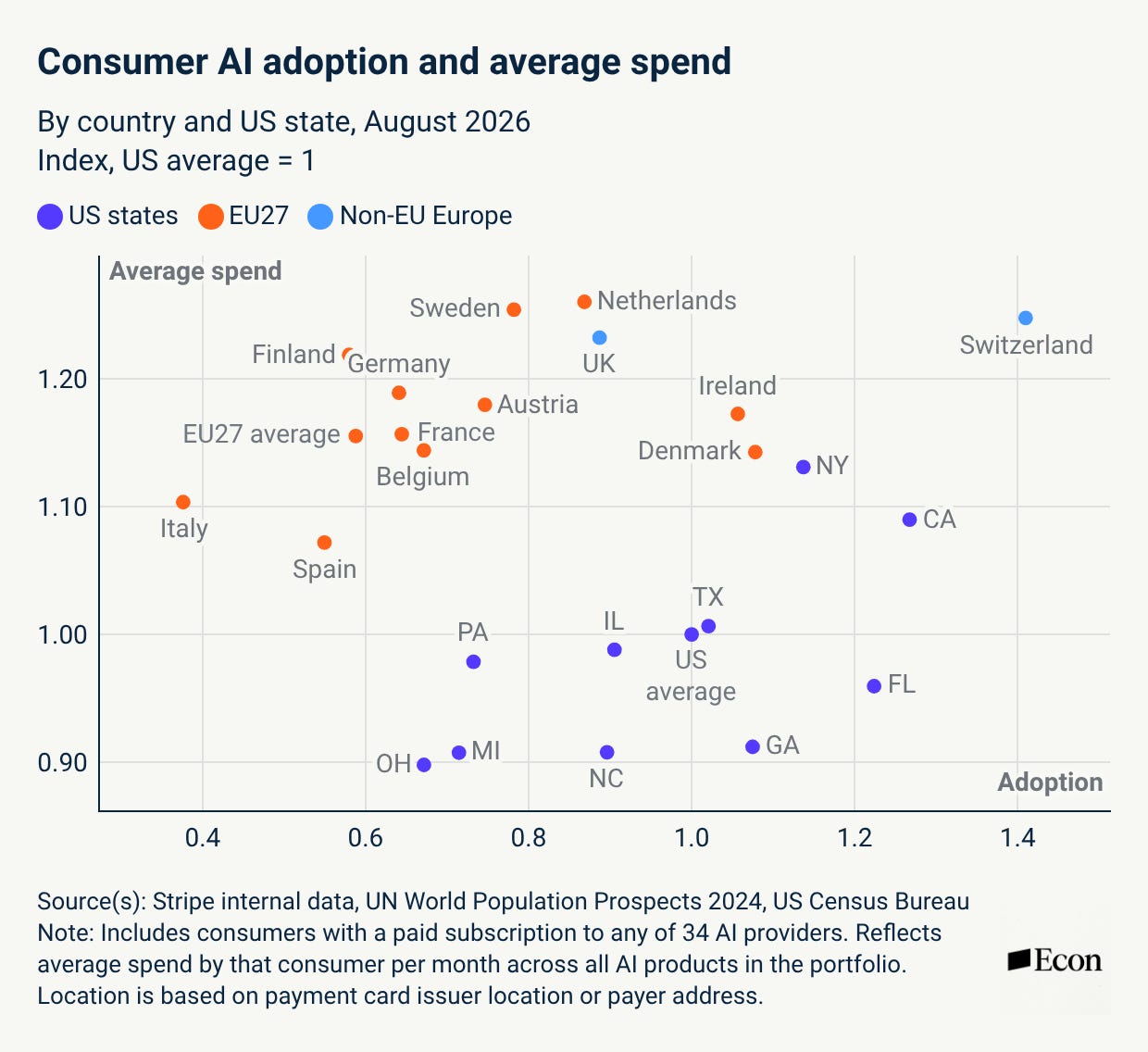
Of course, neither Europe nor the US are monolithic. There are marked differences in adoption and usage rates across US states and EU countries. While on the whole the EU sees lower AI adoption than the US, some EU countries, such as Denmark or Ireland, look more like high-adoption US states. Meanwhile some large US states, such as Ohio or Pennsylvania, look more like the EU average. Switzerland appears to be an outlier on both dimensions, with adoption rates that are almost twice the US average for certain paid AI tools in our sample.
Business adoption: European entrepreneurs use agentic coding tools as much as American founders, but existing businesses lag
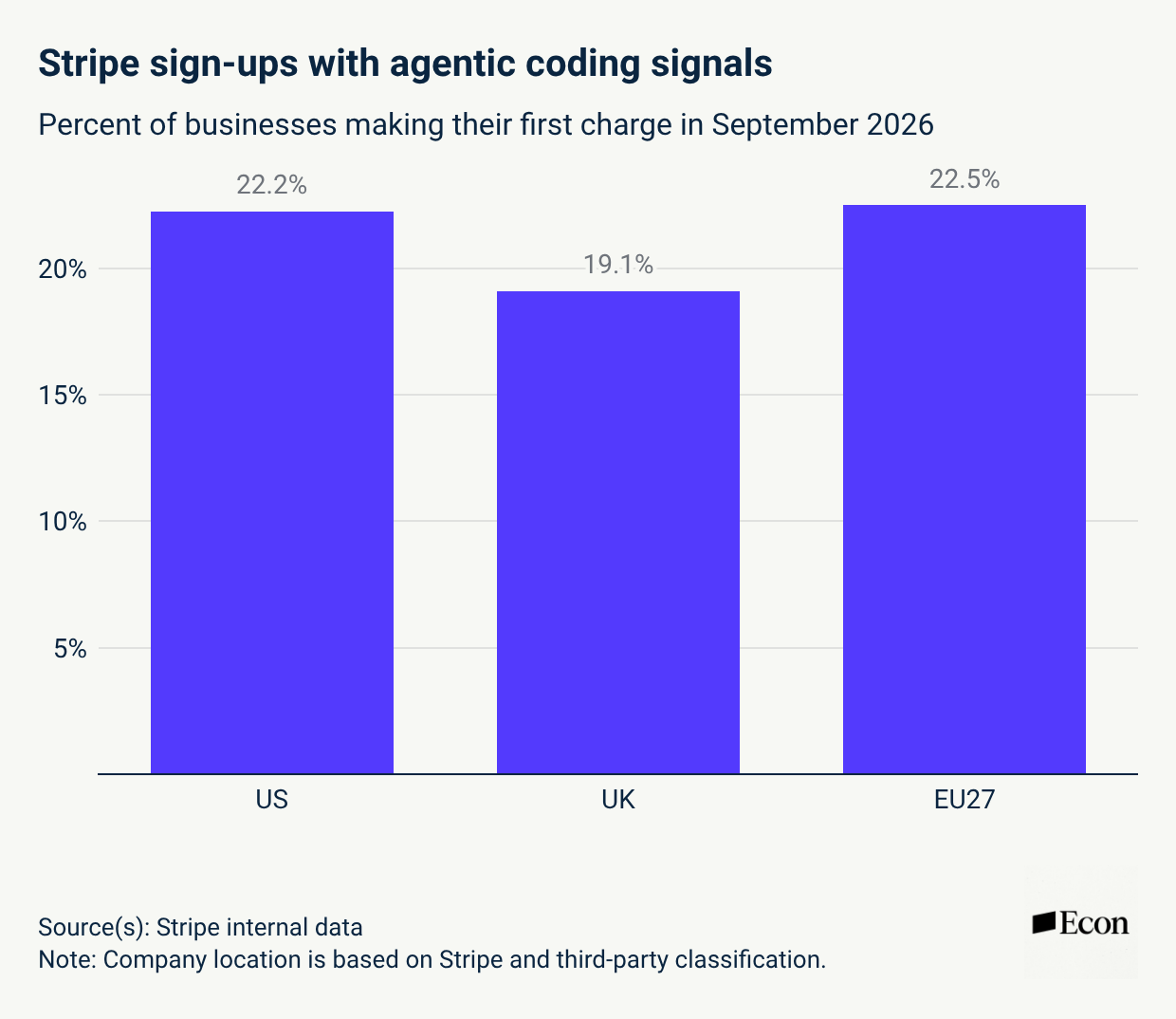
When it comes to businesses adopting these AI products, the US–EU divide is also less stark. Many AI products are served directly via cloud providers, and billing blends AI spend with other cloud spend, making it challenging to cleanly estimate AI adoption among existing businesses. However, Stripe does see another telling signal of AI adoption: the use of AI tools to integrate Stripe itself. This signal is particularly interesting as agentic coding represents a more advanced use of AI than merely using AI chatbots. The share of businesses using AI coding tools to integrate Stripe is remarkably similar across geographies, hovering around 22% in both the US and the EU, and only marginally below at 19% in the UK. Stripe sign-ups are a strong signal of entrepreneurial activity, and these results suggest that entrepreneurs on either side of the Atlantic are using coding tools in equal measure.
Of course, entrepreneurs tend to be more innovative than existing firms. Public data suggests there is more of a gap in AI adoption among existing businesses. Overall business AI adoption is around 20% in both the US and the EU; however, the type of use is very different. As of Q1 2025, only 4% of EU firms with more than 10 employees were using AI in the production of goods or services, compared to 6% in firms of a similar size in the US. More recent EU figures are not available, but adoption in production has climbed to over 8% in the US in the last 12 months, so the gap may have widened further. The development of new production processes is how technology drives productivity increases, so this gap, if it persists, could be very consequential.


Nothing in this analysis negates the challenges that Europe faces at the AI infrastructure and model layer, nor do we seek to minimize their significance. Still, focusing only on this aspect of AI risks missing what is happening in other relevant dimensions. Stripe data allows us to see that, in other layers of the cake, such as in AI application development, and business and consumer adoption of AI tools, the US lead is less marked and Europe is less far behind than people may think.
Many AI companies have both business and consumer offerings. Our analysis excludes any spend on business-focused products (e.g., plans with “business,” “team,” or “enterprise” naming), and we exclude customers for whom we have business signals, such as a VAT ID. We then deduplicate payer IDs across providers to create a view of unique consumers paying for AI in each market.
Yes but AI at Stripe must be low because they send emails that are unreadable because the text does not wrap.