



AI’s economic promise is one familiar to human history: cheaper, more capable tools that raise productivity and prosperity. Even if we assume that AI eventually delivers, much remains unsettled about how, when, and to whom the gains will spread.
Most outside commentary so far has focused on first-order questions, such as AI adoption or token spend, or on the most immediate anxieties around AI, such as automation and job displacement. Those who focus on the long run often do so with either vague promises of a hyperabundant future or predictions of imminent doom. In either case, there are scant details on the path to reach it.
History suggests that many of the most confident predictions about technology are falsified and what gets the most immediate attention is rarely the most consequential. The electrification of America in the early 1920s brought predictions of mass unemployment of factory workers, but not only did US factory employment not fall, it continued rising for more than 50 years, and subsequently declined for reasons largely unrelated to automation (Pierce and Schott, 2012). Meanwhile, predictions about the IT revolution boosting aggregate productivity did eventually become true, but only after decades of IT investment and some puzzlement—most famously from Robert Solow—about the lack of obvious effects on the data (Henry, Sarte, and Taylor, 2024).
Conversely, the most interesting transformations wrought by general purpose technologies are often second-order and unexpected. Women entering the labor force en masse in the 1960s, for example, was made possible by electrification combined with the complementary innovation of indoor plumbing, as well as other social changes (Greenwood, Seshadri, and Yorukoglu, 2004). The internet created entire new job categories that would have been unimaginable to the contemporary commentariat. The majority of employment today is in jobs that did not exist in 1940 and that emerged due to new technologies (Autor et al., 2022).
We believe that AI is likely to follow a similar pattern and that we should therefore approach the study of its impact with humility, curiosity, and rigorous empiricism. The answers to how AI will transform society will depend on how businesses reorganize, markets adjust, and workers respond.
But anyone could endeavor to pursue an empirical research agenda related to AI—and many others are—so why do we believe Stripe Economics has anything original to add? The answer is our data. Stripe, via the products it offers and businesses it serves, produces one of the richest real-time datasets on how today’s economy is evolving, including transaction data on payments, sign-up data on business formation, and survey data on business sentiment. To protect the businesses on Stripe, this data cannot be shared publicly, but the insights and analyses this data produces can. This is what Stripe Economics is for.
We’ve already begun using our data in this way to show that there was convergence, not divergence, in spending between high- and low-income areas of the United States. We shed light on what is behind the recent rise in business formation in the US and elsewhere (that is often not being captured in national statistics). We showed how new AI-era businesses are increasingly forming outside major metros and core urban areas. We showed that the AI-driven market turbulence of early 2026 was not reflective of SaaS business reality.
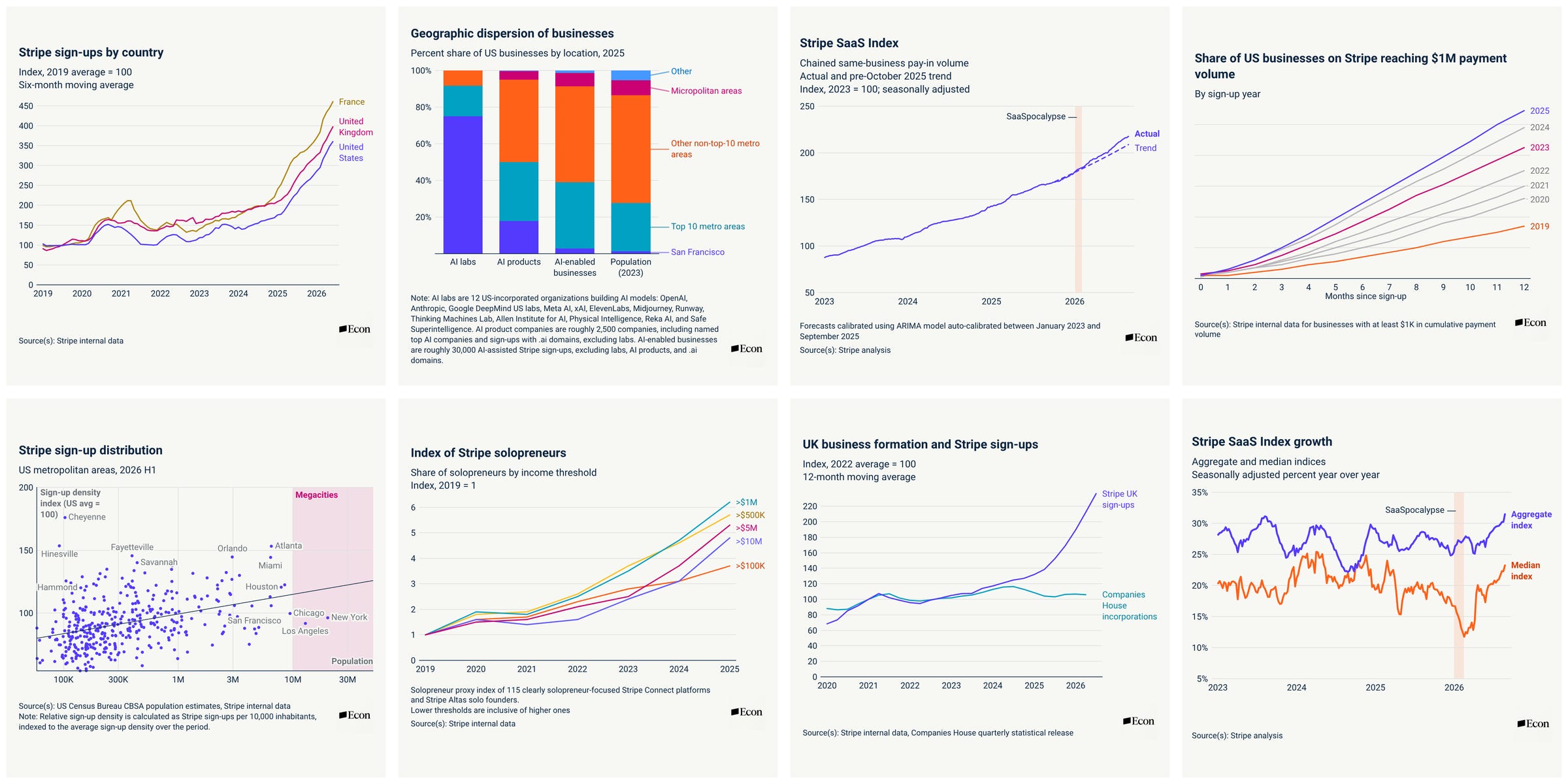
Private data always has some biases. In our case, the primary bias is that Stripe’s user base skews more tech-forward than the economy as a whole. But even this is particularly useful for understanding the current moment. Stripe serves 88% of the Forbes AI 50. We also serve the most tech-forward non-AI businesses, which are digital canaries for how AI is likely to percolate through the economy and affect firms more broadly.
Even with such a privileged starting point, we know that understanding AI’s impact will require data beyond Stripe, approaches beyond economics, and analyses beyond our own. We are sharing our AI research agenda below—and a snapshot of how Stripe data can contribute to answering important questions—to invite others to collaborate with us and contribute. Stripe’s Economics of AI Fellowship already supports early-career researchers studying growth, labor, risk, and market design. We welcome further opportunities for academics, writers, and private-sector researchers to work with us. Suggestions and proposals can be sent to stripeeconomics@stripe.com.
Questions we’re thinking about, and how Stripe data can help answer them
The following is a point-in-time snapshot and assumes future access to OpenRouter data (Stripe's acquisition of OpenRouter has not yet closed), as well as the ability to survey Stripe users on topics such as hiring.
When will aggregate productivity gains materialize?
Economic evidence so far suggests AI is already raising the speed and quality of individual tasks well before those gains appear in revenue, because sales processes, pricing, management, and customer demand adjust more slowly. And if the price of intelligence keeps falling, the net effect on productivity may be pulled in two directions, as lower input costs will drive higher productivity among AI users but might yield lower revenues among AI providers. We expect that AI will eventually move the productivity needle positively, but the interesting story will be the cadence, persistence, and distribution of those gains.
What Stripe data can tell us: the relationship between AI spending and revenue growth, what industries are adopting AI and how intensively
What will be the unexpected complements of AI?
As Alex Imas has pointed out, AI could increase demand for “mimetic goods” like human relationships, judgment, trust, or taste, even as it lowers the price of routine cognition. Similar to travel agents seeing their jobs decline but value rise in the wake of the internet, AI could lead to a premium on human produced and curated content while AI-driven content becomes cheap and accessible. AI could increase leisure time, but it may alternatively raise expectations of productivity within existing work hours. It’s possible that some of the most transformative changes from AI will come from combining it with complementary innovations, such as domestic robots, drones, or AI-directed wetlabs, that extend its impact from the digital to the physical world.
What Stripe data can tell us: what AI-adjacent sectors are seeing rapid growth, changes in the relative prices of different good and services
Will AI create new classes of economic risk?
The recent discourse has emphasized the civilizational risk posed by AI, but we’re at least as concerned with the more traditional variety: macroeconomic risks as AI investment ebbs and flows. AI-enabled cybersecurity attacks on critical infrastructure. The use of AI by terrorists and criminal groups. The rise of AI-assisted autonomous weapons. The rise in AI-assisted fraud and scams. The possibility of a future AI-related incident causing meaningful economic and financial harm is a real one, especially as AI becomes more “systemically important.”
What Stripe data can tell us: how spending on AI-related risks (e.g., cyber) is trending, how different sectors of the economy are impacted by new economic risks
What is the shape of the market for intelligence?
The long-term market structure for intelligence remains unclear. Much of the focus today is on the immediate question of AI lab profitability, but if intelligence becomes a factor of production, then where price and supply of intelligence stabilize will have implications for many parts of the economy. Which jobs are augmented or replaced by AI is at least in part a function of the relative price for humans and machines to execute them. Which new industries emerge depends on how cheaply intelligence can be deployed in pursuit of innovation. Intelligence prices may turn out to have important short- and long-run macroeconomic implications too, in the same way that energy prices do.
What Stripe data can tell us: how token usage and spending are trending, how prices are changing, who is spending more/less on AI, how this relates to various other economic indicators
How will AI affect labor markets?
Attempts so far to identify AI displacement effects have yielded mixed results, with some showing negative effects and others showing muted or even positive effects, with important differences among different subpopulations, industries, and occupations. And AI may already be impacting employment in unexpected ways. Job postings for software engineers are up over the last two years, despite the fact that AI has “cracked” coding. Digital arts jobs are down since 2022, but live arts jobs are up. AI may also be driving job creation and wage growth in unusual places—for example, among electricians to support data center construction. And it remains difficult to disentangle all of these effects from other economic shocks, such as high interest rates and greater adoption of remote work.
What Stripe data can tell us: (via survey) whether new firms are hiring and in what roles, the relationship between AI spend and headcount, changes in output per employee
How will AI reshape competition as well as the structure of the firm?
We’ve already seen a surge in new business formation in the age of AI, particularly among solopreneurs. This may prove to be the new equilibrium: more firms that are smaller on average. On the other hand, AI may also mitigate friction that allows companies to become big in the first place. For example, benefits from proprietary models or increased costs of doing business due to new classes of risk (e.g., cybersecurity) could increase returns to scale.
What Stripe data can tell us: how many new firms are forming and where, what sectors they are in, how fast they are growing, how concentrated industries are
How will agents change broader market dynamics?
Agents go well beyond a simple algorithm and can compare, negotiate, and execute transactions on behalf of humans. This may improve price discovery, reduce transaction costs, and generally increase the efficiency of a wide range of markets. But agents could also be used as rent seekers: looking for inefficiencies and regulations to arbitrage. Sellers will also bring their agents to bear in negotiations, making it hard to predict the net effect on both prices and consumer or producer surplus. And consumer acceptance of a parallel agentic economy is uncertain and will likely be downstream of overall AI adoption.
What Stripe data can tell us: who is using agents to spend, what agents are spending on, how prices change when agents are involved